
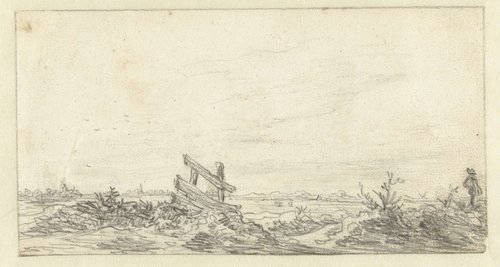
Vergezicht vanuit de duinen
1650 - 1660
Medium
paper
Dimensions
124; 235
Rights
Public Domain
About this artwork
Schenking van F.W.H. Hollstein, Amsterdam
Art Historical Context
**Vergezicht vanuit de du** (Distant View from theunes), created by Dutch Golden Age artist Pieter de Molijn around 1650-1660, captures the expansive beauty of the coastal dunes near Haarlem, where the artist spent much of his life. De Molijn (1595–1661), one of the pioneers of Dutch landscape painting, specialized in serene scenes of beaches, dunes, and distant horizons, often evoking the flat, atmospheric expanses of his homeland. This intimate work on paper, measuring just 124 × 235 mm, invites viewers into a quiet moment of natural grandeur, highlighting his skill in rendering subtle atmospheric depth. As a drawing on paper, the piece reflects the Dutch mastery of monochrome techniques during the 17th century, where artists like de Molijn used ink, wash, or chalk to achieve tonal gradations mimicking oil paintings. This medium allowed for quick studies and personal expressions, bridging studio work and plein-air observation—a hallmark of the tonal landscape movement that influenced later masters like Jacob van Ruisdael. Generously donated by F.W.H. Hollstein, a renowned Amsterdam print scholar, this artwork underscores the enduring value of de Molijn's contributions to early Dutch landscape art. It offers museum visitors a window into the Golden Age's fascination with everyday nature, reminding us how small-scale drawings preserve the era's poetic vision of the world.
About the Artist
Pieter de Molijn · 1595–1661
**Pieter de Molijn** (1595–1661) was a Dutch Golden Age landscape painter of English birth and Flemish descent, baptized on 6 April 1595 in London at the Dutch Reformed Austin Friars church to parents from Ghent and Brussels. His family likely emigrated to England for economic opportunities, but young Pieter returned to the Netherlands, settling in Haarlem where he joined the Guild of St. Luke in ...