
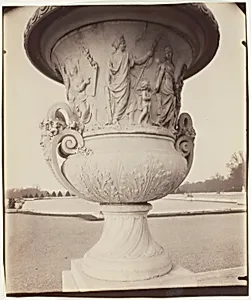
Versailles, Vase par Tuby
Medium
Albumen print
Dimensions
Image: 20.8 × 17.6 cm (8 1/4 × 6 15/16 in.); Paper: 21.3 × 17.9 cm (8 7/16 × 7 1/16 in.)
Classification
albumen silver print
Department
Photography and Media
Museum
Art Institute of Chicago
Accession Number
124292
Rights
Public Domain
Art Historical Context
Step into the sun-dappled gardens of Versailles through Jean-Eugène-Augusteget's *Versailles, Vase par Tuby* (1904), an exquisite albumen print capturing a grand sculptural vase crafted by 17th-century artist Jean-Baptiste Tuby. Atget, a pioneering French photographer (1857–1927), devoted his career to meticulously documenting the architecture, streets, and gardens of Paris and its royal estates, preserving a vanishing world on the cusp of modernity. This image, with its precise composition framing the ornate vase amid lush foliage, exemplifies his unflinching gaze at historical splendor. Atget's work, produced just before World War I, holds immense cultural importance as a visual archive of France's gilded past. Shot at the Palace of Versailles—Louis XIV's opulent symbol of absolute monarchy—the photograph highlights Tuby's Baroque masterpiece, part of the garden's lavish fountain ensemble designed by André Le Nôtre. Atget's straight, unmanipulated style influenced later modernists like Man Ray and Walker Evans, bridging 19th-century documentary photography with 20th-century art. The albumen silver print medium, using egg whites to create rich, warm tones and sharp details on paper (21.3 × 17.9 cm), was a hallmark of 19th-century photography, lending this 20.8 × 17.6 cm image a timeless, velvety depth. Housed in the Art Institute of Chicago's Photography and Media department, it invites us to savor the interplay of light, stone, and shadow in one of history's most iconic landscapes.
About the Artist
Jean-Eugène-Auguste Atget · 1857–1927
Jean-Eugène-Auguste Atget was born on February 12, 1857, in Libourne, France, to working-class parents—a carriage maker father who died in 1862 and a mother who passed away soon after, orphaning him at age six or seven. Raised by his maternal grandparents in Bordeaux, Atget briefly pursued a seafaring life before moving to Paris in the late 1870s to study acting at the Conservatoire d'art dramatiq...