
Versöhnung (The Reconciliation)
1914
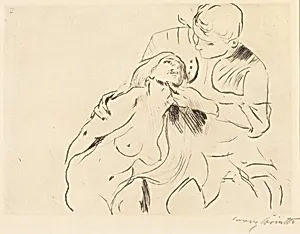
Medium
drypoint in black on Van Gelder Zonen laid paper
Dimensions
plate: 17.5 x 23.7 cm (6 7/8 x 9 5/16 in.) sheet: 33 x 41.2 cm (13 x 16 1/4 in.)
Classification
Department
CG-W
Museum
National Gallery of Art, Washington, D.C.
Credit
Gift of Dr. Toni G. Marcy
Accession Number
1997.118.4
Rights
Public Domain
Art Historical Context
Lovis Corinth's *Versöhnung (The Reconciliation)*, created in 1914, captures the German artist's late-career mastery of printmaking amid a period of personal and national upheaval. Born in 1858, Corinth transitioned from Impressionist influences to a bold Expressionist style, marked by dramatic contrasts and emotional intensity—qualities heightened after his 1911 stroke. This drypoint etching, housed in the National Gallery of Art's print collection (gift of Dr. Toni G. Marcy), evokes themes of harmony and resolution through its evocative title, reflecting perhaps the reconciliatory spirit in art during the eve of World War I. The work's medium—drypoint in black ink on fine Van Gelder Zonen laid paper—highlights Corinth's technical prowess. Drypoint involves scratching directly into a copper plate, raising a soft burr that yields richly textured, velvety lines upon printing, often limited to small editions for intimacy. The modest plate size (17.5 x 23.7 cm) contrasts with the larger sheet (33 x 41.2 cm), allowing the image to breathe amid generous margins, a hallmark of fine art prints that emphasize the handmade quality. As a testament to Corinth's versatility beyond painting, *Versöhnung* exemplifies early 20th-century German graphic innovation, bridging Romanticism and modernism. Visitors will appreciate its tactile depth, inviting close inspection to trace the artist's spontaneous incisions—a window into his expressive soul.
About the Artist
Lovis Corinth · 1858–1925
Lovis Corinth, born Franz Heinrich Louis on July 21, 1858, in Tapiau, East Prussia (now Gvardeysk, Russia), to a tanner father, displayed prodigious drawing talent from childhood. He began formal training at the Königsberg Academy in 1876, then moved to the Academy of Fine Arts in Munich from 1880 to 1884, studying under Ludwig von Löfftz and briefly Franz von Defregger, where he absorbed a Realis...