
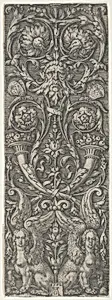
Vertical Panel with Candelabrum Grotesques Containing Cornucopias and Sphinxes
Medium
Engraving
Dimensions
Sheet: 5 11/16 × 2 in. (14.5 × 5.1 cm)
Classification
Prints|Ornament & Architecture
Department
Drawings and Prints
Museum
Metropolitan Museum of Art, New York, NY
Credit
Harris Brisbane Dick Fund, 1926
Accession Number
27.23.79
Rights
Public Domain
Tags
Art Historical Context
In the mid-16th century, engraver Heinrich Aldegver crafted this exquisite *Vertical Panel with Candelabrum Grotes Containing Cornucopias Sphinxes* (1552), a petite engraving measuring just 5 11/16 × 2 inches. Aldegrever, a master of the Northern Renaissance "Little Masters" for their intricate small-scale prints, specialized in ornamental designs that bridged art and craft. This work exemplifies his skill in engraving—a meticulous intaglio technique where lines are incised into a metal plate, inked, and pressed onto paper to yield sharp, durable details ideal for reproducing decorative motifs. The composition bursts with Renaissance grotesques: fantastical candelabra forms intertwined with overflowing cornucopias symbolizing abundance and sphinxes evoking ancient mystery. These motifs, revived from Roman archaeological discoveries like Nero's Domus Aurea, fueled the era's passion for whimsical, hybrid ornamentation. Popular among goldsmiths, architects, and textile designers, Aldegrever's prints served as pattern books, influencing decorative arts across Europe. Today, housed in the Metropolitan Museum of Art's Drawings and Prints department (Harris Brisbane Dick Fund, 1926), this piece highlights how prints democratized high design, making opulent motifs accessible for everyday luxury objects. A testament to Aldegrever's precision, it invites viewers to marvel at the tiny world's boundless imagination.
About the Artist
Heinrich Aldegrever · 1502–1561
Heinrich Aldegrever, born in 1502 in Paderborn, Westphalia, to parents Herman and Katherine Trippenmeker—a family of clog-makers known by the dialect name Trippenmecker—emerged as a multifaceted artist in the German Renaissance. His early training remains undocumented, though he likely apprenticed in a Soest goldsmith's workshop after relocating there around 1525, where he joined the painters' gui...