
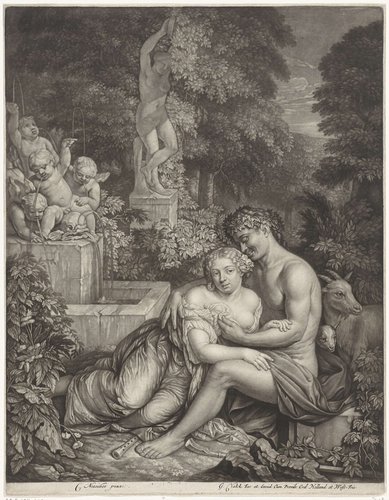
Vertumnus en Pomona
1681 - 1726
Medium
paper
Dimensions
299; 386
Rights
Public Domain
About this artwork
collector's mark: Lugt 2228
Art Historical Context
**Vertumnus en Pom** by Gerard Valck (c 1681–1726) captures a timeless mythological scene from Ovid's *amorphoses*, where the shape-shifting god Vertumnus courts the nymph Pomona. Created during the Dutch Golden Age's waning years, this print reflects the era's fascination with classical tales, blending romance and disguise in a narrative popular among Baroque artists. Valck, a prominent Amsterdam engraver from a family of printmakers, likely drew inspiration from paintings by masters like Rubens, transforming them into accessible works for collectors and scholars. Rendered on paper (386 × 299 mm), the piece showcases Valck's mastery of engraving techniques—fine lines and intricate shading that bring depth and drama to the figures. Printmaking was revolutionary then, allowing widespread sharing of elite art beyond oil paintings, democratizing mythology for Europe's burgeoning middle class. A collector's mark (Lugt 2228) adorns the sheet, hinting at its prized history in a distinguished library or cabinet of curiosities. This modest yet evocative work invites us to ponder love's transformations, bridging ancient lore with 17th-century ingenuity.
About the Artist
Gerard Valck · 1652–1726
Gerard Valck (1652–1726) was a Dutch engraver, publisher, and cartographer whose career bridged the 17th-century Dutch Golden Age and the 18th-century Enlightenment. Born on September 30, 1652, in Amsterdam to a silversmith father, and dying on October 21, 1726, Valck played a crucial role in introducing and developing mezzotint printmaking in England while also establishing a significant publishi...