
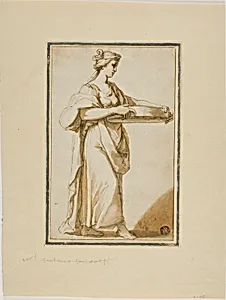
Vestal Virgin Tuccia
n.d.
Medium
Pen and brown, with brush and brown wash, over traces of black chalk, on ivory laid paper, laid down on ivory wove paper and tipped onto cream laid paper
Dimensions
20 × 12.8 cm (7 7/8 × 5 1/16 in.)
Classification
pen and ink drawings
Department
Prints and Drawings
Museum
Art Institute of Chicago
Accession Number
81855
Rights
Public Domain
Art Historical Context
In the intricate pen and brown ink drawing *Vestal Virgin Tuccia Gaetano Gandolfi a pivotal moment from ancient Roman legend. Tuccia, one of Rome's sacred Vestal Vir tasked with maintaining the city's eternal flame and upholding chastity vows, miraculously carried water in a sieve to prove her purity when accused of impurity. Created in the 18th century by the Bolognese artist Gandolfi (1732–1802), part of a prominent family of painters, this reflects the era's fascination with classical antiquity amid the rise of Neoclassicism, blending Rococo elegance with historical gravitas. Gandolfi's masterful technique shines through fine pen lines, subtle brown wash for tonal depth, and traces of black chalk underdrawing on delicate ivory laid paper. At just 20 × 12.8 cm, the sheet—laid down and tipped for preservation—likely served as a preparatory study, showcasing his skill in rendering flowing drapery and expressive gesture to evoke Tuccia's dignified resolve. Housed in the Art Institute of Chicago's Prints and Drawings Department, this drawing highlights the cultural reverence for Vestal Virgins as symbols of Roman piety and moral virtue, themes that resonated in Enlightenment Europe. It invites visitors to ponder how 18th-century artists like Gandolfi revived antiquity to explore timeless ideals of faith and integrity.
About the Artist
Gaetano Gandolfi · 1734–1802
Gaetano Gandolfi (1734–1802) was an Italian painter and draughtsman who, together with his older brother Ubaldo Gandolfi, represented the finest flowering of the Bolognese school during the eighteenth century. Born in San Matteo della Decima, he trained in Bologna under Felice Torelli and Ercole Lelli before entering the Accademia Clementina, the leading artistic institution in the city, where he ...