
Vestment (For a First-degree Taoist Priest)
Qing dynasty (1644–1911), 1850/1900
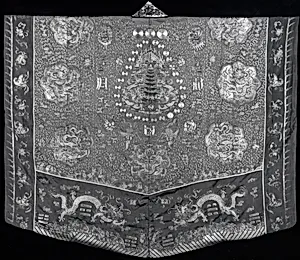
Medium
Silk and cotton, plain weaves and silk, plain weave self-patterned by ground weft floats; embroidered with silk and gold-leaf-over-lacquered-paper-strip-wrapped cotton in chain, eyelet, and satin stitches; laid work and couching; collar and edge trim: silk, warp-float faced 4:1 and 6:1 satin weaves; lined with ramie, plain weave
Dimensions
141.8 × 162.9 cm (55 3/4 × 64 1/8 in.)
Classification
textile
Department
Textiles
Museum
Art Institute of Chicago
Accession Number
25244
Rights
Public Domain
Art Historical Context
This exquisite vestment, designed for first-degree Taoist priest during Qing dynasty (16441911), dates to around1850–1900. Crafted by Han artisans, it reflects the elaborate religious hierarchy Taoism, one of ancient philosophical and spiritual traditions. Taoist priests such garments during rituals, with the "-degree" rank signifying an's entry into priesthood.ed in the Art Institute Chicago's Textiles Department, 141.8 × 1629 cm piece (about55¾ × 64⅛ inches embodies the opulence of imperial China, where silk textiles status and devotion. The vestment's showcases masterful textile techniques: silk and cotton plain weaves, with self-patterned ground we floats for subtle texture. It's richly embroidered silk and innovative gold-leaf-over-lacquered-paper-strip-wrapped cotton threads in chain, eyelet, and satin stitches, plus laid work and couching for dimensional shine. The collar and edges feature luxurious warp-float faced satin weaves (4:1 and 6:1), while the lining of durable ramie plain weave ensured practicality for ceremonial use. These methods highlight Qing-era embroidery's precision, blending functionality with spiritual symbolism—gold evoking divine light. As a rare surviving example of Taoist clerical attire, it offers a window into 19th-century Chinese material culture, where craftsmanship fused art, religion, and imperial refinement. Visitors will appreciate its tactile splendor up close!
About the Artist
Han-Chinese
**Han-Chinese** was the collective attribution given to anonymous artisans of Han Chinese descent who crafted intricate embroidered textiles during the Qing dynasty (1644–1911). These makers, active primarily in the late 18th to early 20th centuries, specialized in luxurious garments and furnishings that showcased the pinnacle of Han Chinese needlework traditions. Their early lives and individual ...