
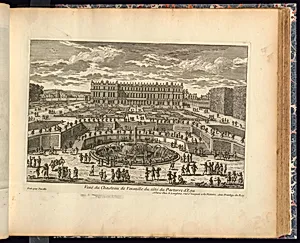
Veuë du Chasteau de Versaille du côté du Parterre d’Eau
late 17th century
Medium
Classification
Department
Smithsonian Collection
Museum
Smithsonian American Art Museum
Credit
Purchased for the Museum by the Advisory Council
Accession Number
1921-6-533-105
Rights
Public Domain
About this artwork
Research in Progress
Art Historical Context
Adam Perelle's *Veuë du Chasteau deaille du côté du Parterre d’E*, created in the late 17 century, offers a captivating printed vista of the Château de Versailles, France's ultimate symbol of royal splendor. As a masterful French engraver (1638–1695), Perelle specialized in detailed topographic views that immortalized the grandeur of Louis XIV's palaces and gardens This work captures the palace from the perspective of the Parterre dau, a meticulously designed water garden feature that exemplified the Sun King's vision of absolute monarchy through landscape architecture. Produced during Versailles' golden age under Louis XIV, the print reflects the era's Baroque obsession with symmetry, scale, and opulence. Perelle's engravings were instrumental in disseminating images of the king's lavish estate across Europe, turning the private royal domain into a public icon of French power and taste. These prints not only documented the evolving gardens—shaped by André Le Nôtre—but also served as propaganda, showcasing France's cultural dominance. As a rare print in the Smithsonian American Art Museum's collection, acquired through the Advisory Council, this piece highlights the medium's role in 17th-century art dissemination. Etchings like Perelle's allowed for precise lines and intricate details, making architectural marvels accessible to collectors far from Versailles. A window into absolutist France, it invites visitors to ponder the fusion of art, power, and nature.