
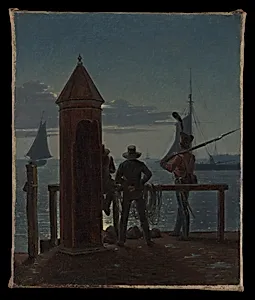
View from the Citadel Ramparts in Copenhagen by Moonlight
1839
Medium
Oil on canvas
Dimensions
11 3/8 x 9 5/8 in. (28.9 x 24.4 cm)
Classification
Paintings
Department
European Paintings
Museum
Metropolitan Museum of Art, New York, NY
Credit
Gift of Eugene V. Thaw, 2007
Accession Number
2007.164.7
Rights
Public Domain
Tags
Art Historical Context
Step onto the moonlit ramparts of Copenhagen Citadel with Martinus Rbye's captivating *View from the Citadel Ramp in Copenhagen by Moonlight (1839). This oil on canvas, measuring just 11⅜ × 9⅝ inches, transports us to Denmark's Golden Age of Painting, Rørbye—a master of luminous landscapes—blended Romanticism with precise observation. Silhouetted soldiers and distant ships emerge from the velvety night, bathed in the ethereal glow of moonlight, evoking a sense of quiet vigilance over the harbor. Painted during a period of national pride and maritime expansion in 19th-century Denmark, the scene nods to the Citadel (Kastellet), a 17th-century star-shaped fortress that symbolized the city's defenses. Rørbye's nocturnal vista captures the Romantic sublime: the interplay of deep shadows and subtle highlights rendered in rich oils, highlighting his skill in atmospheric perspective and everyday heroism amid Denmark's coastal life. Now at The Metropolitan Museum of Art (gift of Eugene V. Thaw, 2007), this gem invites reflection on how moonlight can transform a military outpost into poetry, bridging history and quiet wonder for modern viewers.
About the Artist
Martinus Rørbye · 1803–1848
**Martinus Christian Wesseltoft Rørbye (1803–1848) was a Danish painter celebrated for his genre scenes, landscapes, and architectural views, emerging as a central figure in the Danish Golden Age of painting.** Born on 17 May 1803 in Drammen, Norway, to Danish parents, he moved early to Copenhagen and began studies at the Royal Danish Academy of Fine Arts in 1820. There he trained under Christian ...