
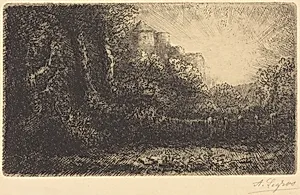
View of a Chateau (Chateau de Poillet)
1826 to 1850
Medium
etching and drypoint?
Classification
Department
CG-E
Museum
National Gallery of Art, Washington, D.C.
Credit
Rosenwald Collection
Accession Number
1943.3.5437
Rights
Public Domain
Art Historical Context
Alphonse Legros, a prominent French artist of the 19th century captures the serene grandeur of the Chateau de Poillet in evocative print, *View of a Chateau Created sometime between 1826 and1850, the work reflects the Romantic interest in picturesque landscapes and historic architecture, Legros's early mastery printmaking. As a key figure bridging Realism and etching traditions influenced by artists like Rembrandt, Legros often depicted French scenes with a keen eye for atmospheric detail, evoking a sense of timeless elegance amid the chateau's towers and surrounding grounds. The medium—etching combined with drypoint—highlights Legros's technical prowess. Etching allows for precise, fluid lines etched into a metal plate with acid, while drypoint adds velvety textures through direct needle scratches, creating rich tonal contrasts and a tactile depth ideal for intimate prints. This technique was revolutionary in the 19th century, making fine art accessible beyond paintings and elevating prints to collector's items. Housed in the National Gallery of Art's Rosenwald Collection (Department CG-E), this piece exemplifies the enduring appeal of 19th-century French graphic arts. Part of a distinguished donation of prints, it invites visitors to appreciate how Legros transformed a simple chateau view into a meditation on heritage and light, bridging everyday scenery with artistic innovation.
About the Artist
Alphonse Legros · 1837–1911
Alphonse Legros (1837–1911) was born in Dijon, France, and trained in Paris at the drawing school of Horace Lecoq de Boisbaudran, whose unconventional teaching method — which emphasised memory drawing and acute observation over academic convention — would leave a lasting mark on Legros's practice. At Lecoq's school he formed friendships with Jules Dalou and Auguste Rodin that endured throughout hi...