
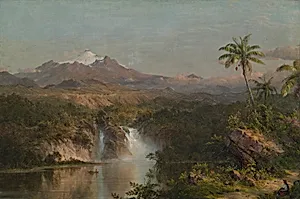
View of Cotopaxi
Medium
Oil on canvas
Dimensions
62.2 × 92.7 cm (24 1/2 × 36 1/2 in.)
Classification
painting
Department
Arts of the Americas
Museum
Art Institute of Chicago
Accession Number
76571
Rights
Public Domain
About this artwork
View of Cotopaxi brings together in visual form scientific, religious, political, and cultural ideas in the mid-19th century. Inspired by German naturalist Alexander von Humboldt’s concept of ecological interconnectedness, Frederic Edwin Church traveled to South America to meticulously study the tropical landscape. The artist produced at least ten finished paintings of the Ecuadorian volcano, this one completed in his studio just before his second visit to the region. For Church and other Christ...
Art Historical Context
Frederic Edwin Church's *View of Cotopaxi (1857) captures the majestic Ecuadorian volcano in a moment of sublime drama, reflecting the artist's fascination with South America's untamed landscapes. A leading figure in the Hudson River School, Church journeyed to Ecuador in 1853 sketching the active Cotopaxi firsthand amid its eruptions. This oil on canvas, measuring 62.2 × 92.7 cm, 19th-century American Romantic, blending scientific observation with spiritual awe inspired by explorer Alexander von Humboldt. Church's masterful technique shines in the luminous sky and intricate foreground details—tiny figures and wildlife emphasize nature's overwhelming scale. His precise brushwork and glowing light effects, hallmarks of Luminism, create an atmospheric depth that draws viewers into the scene's volatile energy, evoking both beauty and peril. Housed in the Art Institute of Chicago's Arts of the Americas collection, this painting symbolizes America's expanding horizons during the era of exploration and Manifest Destiny, inviting us to ponder humanity's place in the vast, divine wilderness.
About the Artist
Frederic Edwin Church · 1826–1900
Frederic Edwin Church (1826–1900), born in Hartford, Connecticut, to a prosperous silversmith and banker father, Joseph Church, pursued art from youth thanks to his family's wealth. At age 18, introduced by patron Daniel Wadsworth, he studied under Thomas Cole in Catskill, New York, from 1844 to 1846, sketching across New England and earning Cole's praise for possessing "the finest eye for drawing...