
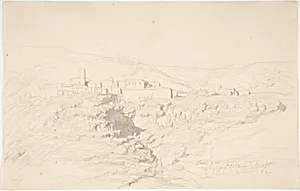
View of Nemi
1843 or 1826
Medium
Graphite on cream wove paper
Dimensions
Sheet: 5 11/16 x 8 15/16 in. (14.5 x 22.7cm)
Classification
Drawings
Department
Drawings and Prints
Museum
Metropolitan Museum of Art, New York, NY
Credit
Bequest of Grégoire Tarnopol, 1979, and Gift of Alexander Tarnopol, 1980
Accession Number
1980.21.8
Rights
Public Domain
Tags
Art Historical Context
Nestled in the Alban Hills south of Rome, *View of Nemi* the serene beauty of the Italian lakeside town of Nemi, a favored sketching spot for 19th-century artists. Attributed to Jean-Baptiste-Camille Corot, the French master of landscape painting and a key figure in the Barbizon, this intimate drawing dates to either 1826 or 1843—likely from one of Corot's trips to Italy. There, he honed his plein-air technique, blending meticulous observation with poetic atmosphere, bridging Neoclassicism and the emerging Impressionism. Rendered in graphite on cream wove paper, the modest 5 11/16 x 8 15/16-inch sheet showcases Corot's signature loose, fluid lines that evoke distant houses, rolling hills, and shimmering water. These preparatory sketches were vital to his process, informing larger oil paintings while preserving the fleeting light and tranquility of the Roman countryside. The notation "Madame C. Bouchot" may hint at a collector's inscription or dedication, adding a personal touch to this evocative study. Today, housed in the Metropolitan Museum of Art's Drawings and Prints department (acquired through the Tarnopol family in 1979–1980), *View of Nemi* invites visitors to appreciate Corot's genius for distilling nature's essence into simple graphite strokes—a testament to his enduring influence on modern landscape art.
About the Artist
Camille Corot|Madame C. Bouchot · 1796–1875
Jean-Baptiste-Camille Corot, born in Paris on July 16, 1796, into a prosperous bourgeois family—his father a former wig maker turned draper, his mother a successful milliner—initially resisted his artistic calling. After a lackluster education at the Lycée Pierre-Corneille in Rouen and failed apprenticeships in business, he abandoned commerce at age 26, thanks to a generous parental allowance foll...