
View of the Flavian Amphitheater, called the Colosseum, from "Vedute di Roma" (Roman Views), part II
ca. 1750–78
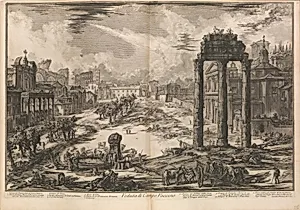
Medium
Etching; second state of four (Hind)
Dimensions
Sheet: 20 1/16 x 28 15/16 in. (51 x 73.5 cm) Plate: 17 5/16 x 27 9/16 in. (44 x 70 cm)
Classification
Prints
Department
Drawings and Prints
Museum
Metropolitan Museum of Art, New York, NY
Credit
Rogers Fund, transferred from the Library
Accession Number
41.71.1.17(37)
Rights
Public Domain
Art Historical Context
Step into ancient Rome through Giovanni Battista Piranesi's masterful etching, *View of the Flavianitheater, called theosseum*, from his renowned series *Vedute di* (Roman Views), Part II. Created around 1750–78, this-state impression captures the iconic Colosseum—Rome's colossal Flavian Amphitheater—in its weathered grandeur. Piranesi, an 18th-century Venetian artist and architect, devoted his career to documenting the Eternal City's ruins, blending meticulous observation with dramatic imagination to evoke the splendor of imperial Rome. Piranesi's vedute were essential during the Grand Tour era, when wealthy Europeans traveled to Italy for cultural enlightenment. His prints not only preserved decaying antiquities but romanticized them, emphasizing vast scale, intricate arches, and encroaching vegetation to highlight Rome's enduring power amid time's decay. This work exemplifies his role in sparking neoclassical revival, inspiring architects and artists across Europe. Etched on a grand plate (17 5/16 x 27 9/16 in.), Piranesi's technique layers fine lines and deep shadows for a sense of depth and atmosphere, making the Colosseum feel alive and immense. Housed in the Metropolitan Museum of Art's Drawings and Prints department, this Rogers Fund acquisition invites us to marvel at how one artist's vision keeps Rome's spectacles eternally vivid.
About the Artist
Giovanni Battista Piranesi · 1720–1778
Giovanni Battista Piranesi (1720–1778) was an Italian printmaker, architect, and antiquarian whose visionary etchings of Rome and imaginary prisons revolutionized architectural representation and profoundly influenced both Neoclassicism and Romanticism. Piranesi stands as one of the most important printmakers of the eighteenth century, fundamentally shaping European perceptions of ancient Rome an...