
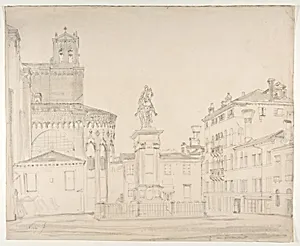
View of the South side of the church of Santi Giovanni e Paolo in Venice, with Verrocchio's statue of Bartolomeo Colleoni
1807–78
Medium
Graphite, brush and gray wash
Dimensions
sheet: 14 13/16 x 18 1/4 in. (37.7 x 46.3 cm)
Classification
Drawings
Department
Drawings and Prints
Museum
Metropolitan Museum of Art, New York, NY
Credit
Purchase, C. G. Boerner Gift, 2008
Accession Number
2008.198
Rights
Public Domain
Tags
Art Historical Context
Friedrich Nerly (1807–1878), a 19th-century artist celebrated for his evocative depictions of Venice, captures grandeur of the city's Campo Santi Giovanni e Paolo in this drawing. Titled *View of the South Side the Church of Santi Giovanni Paolo in Venice, withrocchio's Statue ofolomeo Colleoni*, work showcases the Gothic facade of one of Venice's most imposing churches, framed by the dynamic equestrian sculpture of the condottiero Bartolomeooni. Created with graphite, brush, and gray wash on a generous sheet (14 13/16 x 18 1/4 in.), it belongs to the Metropolitan Museum of Art's Drawings and Prints collection, acquired through the C. G. Boerner Gift in 2008. This monochromatic study highlights the architectural splendor of Renaissance and Gothic Venice, with Verrocchio's bronze statue—erected in 1496—as a focal point. The horse's rearing pose and Colleoni's commanding gesture make it one of Italy's most iconic public sculptures, symbolizing military prowess and Venetian power. Nerly's technique employs subtle gray washes to convey light, shadow, and atmospheric depth, evoking the misty allure of Venetian canals and piazzas. For visitors, this drawing offers a window into 19th-century Romantic fascination with Italy's past, blending precise draftsmanship with a sense of place that immortalizes Venice's timeless blend of faith, history, and artistry.
About the Artist
Friedrich Nerly · 1807–1878
**Friedrich von Nerly** (originally Christian Friedrich Nehrlich, 1807–1878) was a German Romantic painter best known for his luminous vedute of Venice, where he spent most of his adult life. Born in Erfurt to a postal official who died young, he moved at age eight to Hamburg to live with relatives. There he received early drawing instruction from his aunt and later from his uncle, the lithographe...