
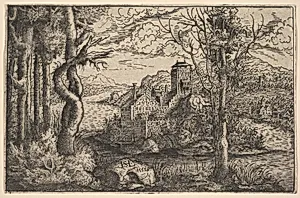
View on a River, with a Castle on an Island
1553
Medium
Etching
Dimensions
sheet: 4 5/16 x 6 3/4 in. (11 x 17.2 cm)
Classification
Prints
Department
Drawings and Prints
Museum
Metropolitan Museum of Art, New York, NY
Credit
Gift of Felix M. Warburg and his family, 1941
Accession Number
41.1.147
Rights
Public Domain
Tags
Art Historical Context
Hanns Lautensack's *View on a River, a Castle on an Island (1553) is a delicate etching that captures the serene beauty of a 16th-century European landscape. Created during the Renaissance in Nuremberg, Germany, where Lautensack worked as a pioneering printmaker, this small work (just 4 5/16 x 6 3/4 inches) showcases a winding river, a majestic castle perched on an island and lush trees framing the scene. Such topographical views were popular in the era, blending real and imagined elements to evoke the Romantic allure of nature and architecture. Etching, the medium Lautensack employs here, was a revolutionary technique in the mid-1500s, allowing artists like him to achieve soft, fluid lines through acid-biting into a metal plate—more spontaneous than traditional engraving. This print exemplifies early mastery of the process, distributing intricate details across an intimate sheet and making landscape imagery accessible beyond paintings. Lautensack's precise yet atmospheric style reflects the Nuremberg school's emphasis on detailed observation, influencing later print traditions. Today, this gem resides in The Metropolitan Museum of Art's Drawings and Prints department, a gift from Felix M. Warburg and his family in 1941. It invites visitors to ponder how 16th-century artists transformed everyday vistas into enduring poetry on paper.
About the Artist
Hanns Lautensack · 1515–1566
Hanns Lautensack, born in 1524 in Bamberg, Germany, was the son of Paul Lautensack, a noted painter and organist. Alongside his brother Heinrich, a goldsmith, the family relocated to Nuremberg in 1527, where Hanns immersed himself in the vibrant artistic milieu of the city. There, he likely apprenticed with a goldsmith, honing skills in fine metalwork that informed his precise etching technique, t...