
Views in Egypt (plates)
1801
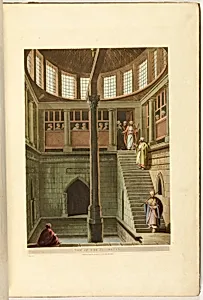
Medium
Book with forty aquatints, with hand-coloring, in black on ivory wove paper
Dimensions
Book, closed: 47.3 × 33.5 × 2.2 cm (18 5/8 × 13 1/4 × 7/8 in.); Book, open: 47.3 × 67.5 × 4.5 cm (18 5/8 × 26 5/8 × 1 13/16 in.)
Classification
book
Department
Prints and Drawings
Museum
Art Institute of Chicago
Accession Number
38378
Rights
Public Domain
Art Historical Context
Luigi Mayer’s *Views in Egypt* (1801) is a splendid example of early nineteenth-century travel that brought the wonders of ancient Egypt to European audiences. The volume contains forty hand-colored aquatints printed in black on ivory wove paper, a medium prized for its ability to capture the subtle tones and luminous effects of watercolor while allowing wide distribution through print. Mayer, an Italian artist working for the British ambassador to the Ottoman Empire, carefully recorded temples, tombs, and Nile landscapes with both topographic accuracy and romantic atmosphere. Published in the wake of Napoleon’s Egyptian campaign, the book arrived at a moment when European fascination with Egypt’s antiquities was reaching new heights. Aquatint’s tonal range made it ideal for conveying the play of light on stone and the vastness of desert settings, helping viewers imagine themselves before the very monuments they could only read about. The Art Institute’s copy, still in its original binding, preserves the intimate scale of these hand-finished plates, inviting close study of both the ancient sites and the artistic techniques that first made them familiar to Western eyes.