
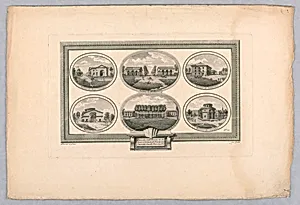
Vignettes of French Buildings
18th century
Classification
Department
Smithsonian Collection
Museum
Smithsonian American Art Museum
Credit
Gift of Eleanor and Sarah Hewitt
Accession Number
1931-94-563
Rights
Public Domain
About this artwork
Research in Progress
Art Historical Context
### Vignettes of French Buildings Step into the architectural splendor of 18th-century France through *Vignettes of French*, a captivating print by Antoine Joseph Gait, a French artist of the era. Created during a time when France was a hub of Enlightenment innovation and ornate design, this work features small, illustrative scenes—known as vignettes—that highlight notable buildings. As a print, it exemplifies how such mediums democratized art and architecture, allowing designs to be widely reproduced and shared among architects, builders, and enthusiasts far beyond the elite workshops of Paris. Gaitte's piece reflects the period's fascination with classical and baroque structures, capturing the grandeur of French edifices in concise, decorative formats often used in books or portfolios. Prints like this were essential tools for preserving and disseminating architectural knowledge, influencing construction across Europe. Though the exact printing technique remains under study, its survival in the Smithsonian American Art Museum's collection—thanks to the generous gift of Eleanor and Sarah Hewitt—underscores its enduring value. Today, as research continues, *Vignettes* invites us to appreciate the intricate interplay of art and architecture, offering a window into France's built heritage and the artistry that immortalized it.