
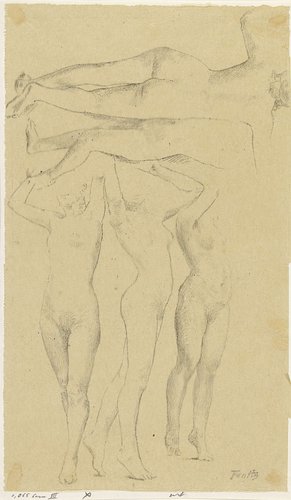
Vijf naaktstudies; drie met opgeheven armen
1846 - 1904
Medium
tracing paper
Dimensions
257; 152
Rights
Public Domain
About this artwork
hoogte 257 mm x breedte 152 mm
Art Historical Context
Henri Fantin-Latour's *Vijf naaktstudies drie met opgeheven* (Five Nude; Three with Raised Arms) showcases the meticulous draftsmanship of this 19th-century French artist (1836–1904). Created during his formative years, these intimate sketches capture dynamic poses of the nude figure—five studies in total, with three dramatically raising their arms. Fantin-Latour, by the academic traditions of the École desaux-Arts, honed his skills through such life drawing exercises, blending Realism's precision with a sensitivity to form and movement. Rendered on delicate tracing paper (257 × 152 mm), the medium is particularly significant. Tracing paper allowed artists like Fantin-Latour to overlay and refine contours from life models or master copies, facilitating the iterative process central to classical training. This translucent support lends the works an ethereal quality, emphasizing line over volume and revealing the artist's exploratory hand. These studies exemplify the nude as a cornerstone of artistic education in 19th-century Europe, underscoring Fantin-Latour's later mastery in portraiture and still lifes. For visitors, they offer a window into the disciplined craft behind his renowned paintings, inviting appreciation of the human form's timeless grace.
About the Artist
Henri Fantin-Latour · 1836–1904
Ignace Henri Jean Théodore Fantin-Latour was born on January 14, 1836, in Grenoble, France, to portrait painter Théodore Fantin-Latour, who gave him his earliest drawing lessons. The family relocated to Paris in 1841, where in 1850, at age 14, he enrolled in the École de Dessin, studying under Horace Lecoq de Boisbaudran, whose innovative memory-based method of drawing from observation profoundly ...