
Vikings (Wikinger)
1922
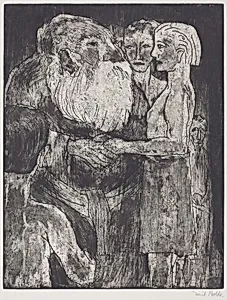
Medium
etching and aquatint in black on wove paper
Dimensions
plate: 32.39 × 25.08 cm (12 3/4 × 9 7/8 in.) sheet: 63.18 × 45.4 cm (24 7/8 × 17 7/8 in.)
Classification
Department
CG-W
Museum
National Gallery of Art, Washington, D.C.
Credit
Rosenwald Collection
Accession Number
1950.17.341
Rights
Public Domain
Art Historical Context
Emil Nolde’s “Vikings (Wikinger)” of 1922 captures a sense of primal energy through the expressive possibilities of printmaking. Created as an etching and aquatint in black onove paper, the work the medium’s capacity for deep, velvety blacks and textured surfaces. These techniques allow Nolde to suggest rugged forms and dramatic contrasts that evoke the mythic world of ancient seafarers. Nolde, a central figure in German Expressionism, frequently drew on Nordic themes rooted in his own Schleswig upbringing. Produced in the unsettled years after World War I, the print reflects a broader cultural interest in ancestral strength and identity. The generous margins of the sheet further emphasize the intensity of the image, inviting viewers to contemplate both the subject and the artist’s bold handling of tone. Today the work resides in the Rosenwald Collection at the National Gallery of Art, where it stands as a compelling example of early twentieth-century printmaking at its most evocative.
About the Artist
Emil Nolde · 1867–1956
Emil Nolde, born Hans Emil Hansen on August 7, 1867, near the village of Nolde in what was then Prussian Schleswig (now Denmark), grew up on a farm amid devout Protestant Danish and Frisian peasant parents. The youngest of four brothers, he apprenticed as a woodcarver and illustrator in Flensburg from 1884 to 1891, working in furniture factories before studying at the School of Applied Arts in Kar...