
Village Among the Trees
Medium
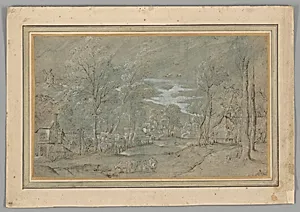
Pen and brown ink, heightened with opaque white watercolor and touches of pink and yellow watercolor, over black chalk, on blue tinted laid paper, laid down on laid paper
Dimensions
Primary support: 23.8 × 39.4 cm (9 3/8 × 15 9/16 in.); Secondary support: 33.9 × 49 cm (13 3/8 × 19 5/16 in.)
Classification
pen and ink drawings
Department
Prints and Drawings
Museum
Art Institute of Chicago
Accession Number
23119
Rights
Public Domain
About this artwork
This rare and unusually early landscape drawing was made on paper prepared with blue wash to create a middle tone to which the artist added both darker elements in the brown ink and lighter ones with white and colored watercolors.
Art Historical Context
Created around 1560, *Village Among the Trees* exemplifies the growing interest in landscape as an independent subject during the Northern Renaissance. The anonymous artist known as the Master of the Small Landscapes produced intimate, meticulously observed rural scenes that helped elevate everyday countryside views to the level of serious art. These works often circulated as designs for prints, spreading the new appreciation for natural settings across Europe. The drawing’s delicate technique enhances its atmospheric quality. Using pen and brown ink over black chalk on blue-tinted paper, the artist added white opaque watercolor for highlights and subtle touches of pink and yellow to suggest light and seasonal color. The cool blue ground serves as a mid-tone, allowing the white to create convincing effects of sunlight filtering through foliage—an innovative approach that gives the scene remarkable depth and luminosity within a modest format. Housed in the Art Institute of Chicago’s Prints and Drawings collection, this sheet reflects the period’s shift toward direct observation of nature while demonstrating the refined draftsmanship prized by sixteenth-century collectors.