
Ville-d'Avray
1870
Medium
Oil on canvas
Dimensions
21 5/8 x 31 1/2 in. (54.9 x 80 cm)
Classification
Paintings
Department
European Paintings
Museum
Metropolitan Museum of Art, New York, NY
Credit
Catharine Lorillard Wolfe Collection, Bequest of Catharine Lorillard Wolfe, 1887
Accession Number
87.15.141
Rights
Public Domain
Tags
Art Historical Context
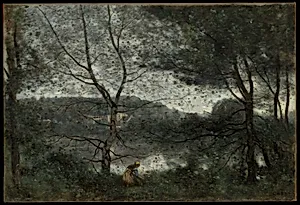
Camille Corot's *Ville-d'Avray* (1870), an oil on canvas measuring 21⅝ × 31½ inches, captures the serene beauty of the French countryside near Paris, where the artist maintained a beloved studio and home. Painted late in Corot's career—he would pass away just five years later—this work exemplifies his mastery of the Barbizon school's poetic landscapes, blending meticulous detail with atmospheric softness. As a precursor to Impressionism, Corot's subtle handling of light filtering through trees creates a dreamlike harmony between nature and human presence, evident in the tags highlighting women amid lush forests. The painting's tranquil scene likely draws from Corot's intimate observations of Ville-d'Avray's wooded paths and ponds, a recurring motif in his oeuvre that evoked nostalgia for the unspoiled rural idyll amid France's rapid industrialization. His oil technique—layered glazes and fluid brushwork—lends a luminous, almost ethereal quality, inviting viewers to linger in its quiet reverie. Acquired through the Catharine Lorillard Wolfe Collection and now housed in the Metropolitan Museum of Art's European Paintings department, *Ville-d'Avray* stands as a testament to Corot's enduring influence on modern landscape art, offering visitors a window into 19th-century Romanticism's gentle embrace of nature.
About the Artist
Camille Corot · 1796–1875
Jean-Baptiste-Camille Corot, born in Paris on July 16, 1796, into a prosperous bourgeois family—his father a former wig maker turned draper, his mother a successful milliner—initially resisted his artistic calling. After a lackluster education at the Lycée Pierre-Corneille in Rouen and failed apprenticeships in business, he abandoned commerce at age 26, thanks to a generous parental allowance foll...