
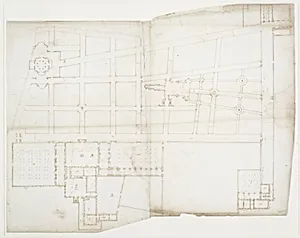
Ville d'Este, Gardens, Quirinal, plan (recto) blank (verso)
early to mid-16th century
Medium
Pen and brown ink, brush and brown wash over traces of black chalk
Dimensions
mount: 30 x 40 in. (76.2 x 101.6 cm)
Classification
Drawings
Department
Drawings and Prints
Museum
Metropolitan Museum of Art, New York, NY
Credit
Gift of Janos Scholz and Anne Bigelow Scholz, in memory of Flying Officer Walter Bigelow Rosen, RCAF, 1949
Accession Number
49.92.8
Rights
Public Domain
Tags
About this artwork
This architectural drawing captures the celebrated gardens of the Villa d'Este at Tivoli, one of Renaissance Italy's most ambitious and influential landscape designs. Created in the early to mid-sixteenth century by an anonymous French draftsman, the plan documents the villa's elaborate terraced gardens with their famous fountains, cascades, and hydraulic marvels that transformed the hillside site into an earthly paradise celebrating both classical mythology and princely magnificence. Cardinal I...
Art Historical Context
Step into the lush legacy of Renaissance Italy with this exquisite 16th-century architectural drawing, a precise plan of the Villa d'Este gardens atoli (recto) alongside the Quirinal hill (ed in the title). Crafted by an anonymous Frenchman in the early to mid-1500s using pen and brown ink, brush and brown wash faint black chalk traces, it captures the villa's terraced splendor—fountains, cascades, and wonders that turned a hillside into a mythical paradise. Commissioned 1550 by Cardinalppolito II d'Este and designed by architect Pirro Ligorio, these gardens rivaled ancient Roman villas, blending classical mythology with displays of princely power. This drawing's significance lies in its role as both document and inspiration. French artists avidly studied Italian innovations, and this plan meticulously notes garden features and layouts, aiding the transmission of ideas that shaped European landscape architecture—from compositional harmony to engineering feats. The Villa d'Este revolutionized garden design by weaving architecture, water, sculpture, and greenery into immersive experiences, influencing later masterpieces like Vaux-le-Vicomte and Versailles. A generous gift to the Metropolitan Museum of Art in 1949, this mounted sheet (30 x 40 in.) from the Drawings and Prints department offers a window into how Renaissance ingenuity crossed borders, forever elevating the art of the garden.