
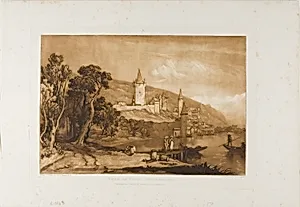
Ville de Thun, plate 59 from Liber Studiorum
published January 1, 1816
Medium
Etching and engraving in brown on ivory laid paper
Dimensions
Image: 17.9 × 26.5 cm (7 1/16 × 10 7/16 in.); Plate: 20.9 × 29.2 cm (8 1/4 × 11 1/2 in.); Sheet: 26.5 × 38.5 cm (10 7/16 × 15 3/16 in.)
Classification
etching
Department
Prints and Drawings
Museum
Art Institute of Chicago
Accession Number
50175
Rights
Public Domain
Art Historical Context
**Ville de Thun, plate 59 from *Liber Studiorum*** Joseph Mallord William Turner, the preeminent British Romantic artist, created this evocative print as part of his ambitious *Liber Studiorum* (1807–1819). Inspired by 17th-century master Claude Lorrain'sLiber Veritatis*, Turner's 71-plate project showcased his versatility across landscape categories like mountainous, pastoral, and architectural scenes. Published on January 1, 1816, *Ville de Thun* captures the Swiss town of Thun nestled amid dramatic Alpine scenery, embodying Romanticism's awe for nature's sublime power. Printed in warm brown ink on ivory laid paper via etching and engraving, the 17.9 × 26.5 cm image reveals Turner's innovative technique. He personally etched many plates, layering mezzotint and line engraving to mimic the luminous effects of his oil paintings—soft atmospheric haze, sparkling water, and intricate architectural details. This hybrid process allowed subtle tonal gradations, bridging painting and printmaking. Housed in the Art Institute of Chicago's Prints and Drawings Department, this work highlights Turner's influence on 19th-century print culture, making his visionary landscapes accessible beyond elite patrons. Visitors will appreciate how it evokes wanderlust, blending precise observation with emotional grandeur. (198 words)
About the Artist
Joseph Mallord William Turner · 1775–1851
Joseph Mallord William Turner, born on 23 April 1775 in London's Covent Garden to barber William Turner and Mary Marshall, emerged as a child prodigy amid personal hardships. His mother suffered mental illness and died in Bethlem Hospital in 1804, while his father supported his early sketches by displaying them in his shop. Around age 10, Turner stayed with his uncle Joseph Mallord William Marshal...