
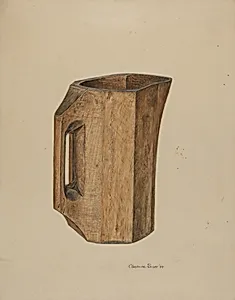
Vinegar Measure
1939
Medium
watercolor and graphite on paperboard
Dimensions
overall: 35.5 x 28.1 cm (14 x 11 1/16 in.) Original IAD Object: 9 1/4" high; 5 1/4" wide
Classification
Index of American Design
Department
CG-W
Museum
National Gallery of Art, Washington, D.C.
Credit
Index of American Design
Accession Number
1943.8.12586
Rights
Public Domain
Art Historical Context
**Vinegar Measure** by Clarence Secor, created in 1939, is a meticulous watercolor and graphite rendering on paperboard, measuring 35.5 x 28.1 cm. This piece captures the humble yet elegant form of an early American vinegar measure—a practical household tool likely used for portioning vinegar in colonial kitchens or apothecaries. Secor's precise lines and subtle washes highlight the object's simple curves, wooden construction, and functional spout, evoking the everyday craftsmanship of pre-industrial America. As part of the Index of American Design (IAD), a New Deal-era Federal Art Project from 1935 to 1942, this work exemplifies a nationwide effort to document and celebrate the nation's folk art and design heritage during the Great Depression. Artists like Secor produced over 15,000 such detailed plates, preserving artifacts that might otherwise be lost to time. Housed in the National Gallery of Art's collection, it underscores the IAD's role in fostering national pride through art. Secor's technique blends graphite's sharp detailing with watercolor's soft tonal depth, making the vinegar measure appear almost tangible. This artwork invites visitors to appreciate the artistry in utilitarian objects, revealing how ordinary tools embodied American ingenuity and resourcefulness.