
Holy Water Font
1935/1942
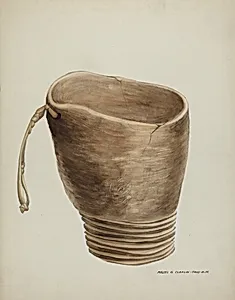
Medium
watercolor, graphite, and pen and ink on paper
Dimensions
overall: 36 x 28.6 cm (14 3/16 x 11 1/4 in.)
Classification
Index of American Design
Department
CG-W
Museum
National Gallery of Art, Washington, D.C.
Credit
Index of American Design
Accession Number
1943.8.14783
Rights
Public Domain
Art Historical Context
Behold the delicate rendering *Holy Water Font* by Majel G. Claflin, crafted between 1935 and1942 as part of the Index of American Design. This Federal Art Project, launched during the Great Depression under the Works Progress Administration (WPA), employed artists across the U.S. to meticulously document everyday objects, folk art, and crafts that embodied American cultural heritage. Claflin's captures the graceful form of a holy water font—a vessel used in Catholic rituals for blessing with holy water—preserving its historical and spiritual significance in precise detail. Executed in watercolor, graphite, and pen and ink on paper (36 x 28.6 cm), the piece showcases the Index's signature style: hyper-realistic illustrations that blend artistic finesse with scientific accuracy. The layered media allow for vibrant hues in the watercolor, fine lines from pen and ink for intricate carving or ornamentation, and graphite for subtle shading, making the font's curves and textures leap off the page. This technique not only highlighted overlooked treasures of American design but also elevated them to fine art status. Housed in the National Gallery of Art, this artwork reflects a pivotal era when New Deal programs championed creativity amid economic hardship, safeguarding ecclesiastical objects that wove faith into the fabric of early American life. A testament to cultural preservation, it invites us to appreciate the quiet beauty in sacred utility.
About the Artist
Majel G. Claflin · 1893–1941
Majel G. Claflin (1893–1941) was an American artist best known for her meticulous documentation of Spanish Colonial folk art from northern New Mexico. Active in Taos, New Mexico, during the late 1930s, she produced watercolor renderings as part of the Index of American Design, a Federal Art Project under the Works Progress Administration that aimed to catalog regional American crafts and tradition...