
Violin
ca. 1685
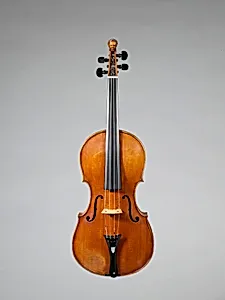
Medium
Spruce, maple
Dimensions
23 1/4 × 7 15/16 × 3 1/2 in. (59.1 × 20.2 × 8.9 cm)
Classification
Chordophone-Bowed
Culture
German
Department
Musical Instruments
Museum
Metropolitan Museum of Art, New York, NY
Credit
Purchase, Clara Mertens Bequest, in memory of André Mertens, 1992
Accession Number
1992.333
Rights
Public Domain
Art Historical Context
Step into the resonant world of Baroque craftsmanship with *Violin* by Joachim Tielke, around 1685 in Germany. This chordophone-bowed instrument, housed in the Metropolitan Museum Art's Department of Musical Instruments, measures 23¼ × 7⅞ × 3½ inches and exemplifies the meticulous lutherie of the era. Tielke, a master maker based in Hamburg, contributed to the evolution of string instruments during a time when the violin family was gaining prominence in European courts and concert halls, accompanying the rise of composers like Corelli and Purcell. The violin's construction highlights time-honored materials: a spruce top for its lightweight strength and superior vibration, paired with maple for the back and sides, ensuring clarity and projection of tone. These choices reflect German precision in woodworking, optimized for the bowed chordophone's demands in polyphonic Baroque music. Though violins originated in Italy, Tielke's work adapted and refined the form, blending functionality with artistry. Acquired in 1992 through the Clara Mertens Bequest in memory of André Mertens, this piece invites us to appreciate not just its sound—but its survival as a cultural artifact from a golden age of musical innovation.