
Virgin Adoring the Christ Child
after 1479
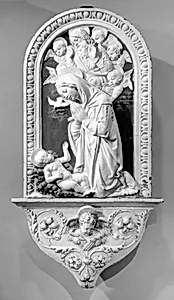
Medium
Glazed terracotta
Dimensions
Overall: 40 1/4 × 21 1/4 × 5 in. (102.2 × 54 × 12.7 cm)
Classification
Sculpture
Culture
Italian, Florence
Department
European Sculpture and Decorative Arts
Museum
Metropolitan Museum of Art, New York, NY
Credit
Bequest of Adele L. Lehman, in memory of Arthur Lehman, 1965
Accession Number
65.181.24
Rights
Public Domain
Tags
Art Historical Context
In the serene glow of Renaissance Florence, Andrea della Robbia crafted *Virgin Adoring the Christ* after 1479, a exquisite example of the family's signature glazed terracotta technique. This medium, perfected by the Della Robbia workshop, involved firing clay sculptures with a vibrant, durable enamel glaze—often in signature whites, blues, and golds—that protected them from the elements, making them ideal for both indoor altarpieces and outdoor church decorations. Measuring over three feet tall, this relief sculpture captures a tender moment of devotion, with the Virgin Mary gazing lovingly at the infant Christ, accompanied by angels in a harmonious composition. Della Robbia's style, rooted in the Florentine Renaissance, blended Gothic sweetness with emerging naturalism, emphasizing emotional intimacy in religious iconography. The glossy surface and rounded, high-relief forms create a luminous, almost jewel-like quality, inviting viewers to contemplate the divine humanity of Mary and her son. Popular in 15th-century Italy, such works adorned homes, chapels, and public spaces, serving as accessible aids to prayer for the faithful. Today, housed in the Metropolitan Museum of Art's European Sculpture and Decorative Arts department, this piece—bequeathed in 1965—exemplifies the enduring legacy of Florentine craftsmanship, bridging art and spirituality for modern audiences.
About the Artist
Andrea della Robbia · 1435–1525
Andrea della Robbia was one of the most successful and prolific of the della Robbia family. He trained with his uncle, Luca della Robbia, assisting in his workshop, and by 1470, had assumed its supervision. Typically, his works are more complex than Luca's, with more expressive figures and compositions. He worked on many commissions during the 1470s, and also began a series of tin-glazed terracott...