
Virgin Adoring the Christ Child
after 1479
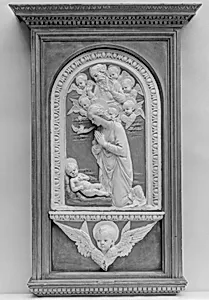
Medium
Relief: glazed terracotta; frame: gilt wood (not original)
Dimensions
36 × 18 1/2 in. (91.4 × 47 cm)
Classification
Sculpture
Culture
Italian, Florence
Department
European Sculpture and Decorative Arts
Museum
Metropolitan Museum of Art, New York, NY
Credit
Bequest of George D. Pratt, 1935
Accession Number
39.186.2
Rights
Public Domain
Tags
Art Historical Context
In the serene glow of glazed terracotta, Andrea della Robbia's *Virgin Adoring the Christ Child* (after 1479) captures a tender moment of divine motherhood from Renaissance Florence. This relief sculpture, measuring 36 × 18½ inches, showcases the artist's mastery of the Della Robbia family's signature technique: vibrant, tin-glazed earthenware that mimics the luminosity of enamel while offering durability for both indoor altarpieces and outdoor niches. The original gilt wood frame enhances its devotional elegance, though it's a later addition. Crafted in the workshops of Florence—cradle of the Italian Renaissance—this work embodies the era's fervent religious piety and humanistic warmth. Andrea, nephew and successor to Luca della Robbia, refined the family's polychrome glazes, often featuring signature blues, whites, and golds to evoke celestial light. Here, the Virgin Mary kneels in adoration of the infant Jesus, surrounded by symbolic elements like birds (perhaps representing the Holy Spirit), cherubic figures akin to Cupid, and attendant men, blending sacred narrative with playful Renaissance motifs. Housed in the Metropolitan Museum of Art's European Sculpture and Decorative Arts department (bequest of George D. Pratt, 1935), this piece invites visitors to ponder the intimate humanity of the holy family, a timeless theme that adorned Florentine homes and chapels, bridging art and spirituality.
About the Artist
Andrea della Robbia · 1435–1525
Andrea della Robbia was one of the most successful and prolific of the della Robbia family. He trained with his uncle, Luca della Robbia, assisting in his workshop, and by 1470, had assumed its supervision. Typically, his works are more complex than Luca's, with more expressive figures and compositions. He worked on many commissions during the 1470s, and also began a series of tin-glazed terracott...