
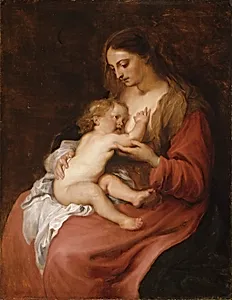
Virgin and Child
ca. 1620
Medium
Oil on wood
Dimensions
25 1/4 x 19 1/2 in. (64.1 x 49.5 cm)
Classification
Paintings
Department
European Paintings
Museum
Metropolitan Museum of Art, New York, NY
Credit
Fletcher Fund, 1951
Accession Number
51.33.1
Rights
Public Domain
Tags
Art Historical Context
In the early Baroque masterpiece *Virgin and Child* (ca. 1620), Anthony van Dyck captures a deeply intimate moment between the Virgin Mary and the infant Christ. Painted in oil on wood—a favored medium for portable devotional panels—this compact work (25¼ × 19½ in.) glows with the artist's signature luminosity and tender realism. The tags hint at a nursing Madonna, a motif emphasizing Mary's humanity and maternal love, which resonated in Counter-Reformation Europe as a way to draw worshippers closer to the divine. Van Dyck, a prodigious Flemish painter and protégé of Peter Paul Rubens, was in his early twenties when he created this piece in Antwerp. His Baroque style shines through in the soft, radiant flesh tones, dynamic drapery, and emotional warmth, blending Rubens's dramatic vigor with van Dyck's emerging elegance. Such images were cherished in private homes and chapels, fostering personal piety amid religious upheavals. Acquired by The Metropolitan Museum of Art through the Fletcher Fund in 1951, this painting exemplifies van Dyck's early mastery and the enduring appeal of Madonna and Child iconography. Visitors, pause to admire how its gentle gaze invites quiet reflection on faith and motherhood.
About the Artist
Anthony van Dyck · 1599–1641
Sir Anthony van Dyck (1599-1641) was a Flemish Baroque artist who revolutionized portrait painting and became the most influential court painter in 17th-century England. Born in Antwerp as the seventh of twelve children to a prosperous silk merchant, van Dyck displayed extraordinary artistic talent from childhood. He trained under Hendrick van Balen before joining Peter Paul Rubens's workshop as a...