
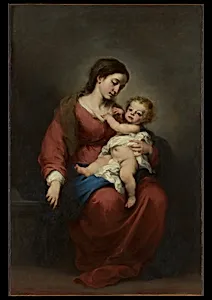
Virgin and Child
Medium
Oil on canvas
Dimensions
65 1/4 x 43 in. (165.7 x 109.2 cm)
Classification
Paintings
Department
European Paintings
Museum
Metropolitan Museum of Art, New York, NY
Credit
Rogers Fund, 1943
Accession Number
43.13
Rights
Public Domain
Tags
Art Historical Context
Bartolomé Esteban Murillo’s *Virgin and Child* captures the tender intimacy between the Madonna and the infant Christ, a subject the artist returned to throughout his career. Painted in Seville during the 1670s, the work belongs to the Spanish Baroque, a period when religious art was commissioned to inspire devotion amid the Catholic Church’s efforts to reach the faithful through emotionally resonant images. Murillo’s soft modeling and warm, luminous palette invite viewers to feel a personal connection to the holy figures rather than simply admire them from afar. Executed in oil on canvas, the medium allowed Murillo to achieve the gentle transitions of light and delicate flesh tones for which he is celebrated. The generous scale—over five feet tall—further emphasizes the monumental yet approachable presence of the Virgin and Child, making the painting well suited for private chapels or aristocratic collections. Today in the Metropolitan Museum’s European Paintings galleries, the canvas continues to exemplify Murillo’s gift for combining technical refinement with heartfelt spirituality.
About the Artist
Bartolomé Estebán Murillo · 1617–1682
Son of Gaspar Esteban, a barber-surgeon, and María Pérez. He was orphaned at the age of ten and brought up by his maternal uncle, who placed him as an apprentice with his relative Juan del Castillo, a painter in the Italian manner. He adopted the surname of his maternal grandmother, Elvira Murillo, and rarely signed or used that of his father. Comment on works: History; Portraits; Religious