
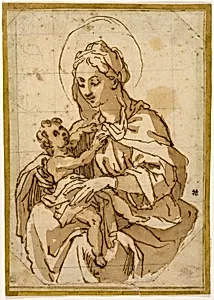
Virgin and Child
c. 1591
Medium
Pen and iron gall ink with brush and brown wash, on ivory laid paper, squared in graphite
Dimensions
14 × 10 cm (5 9/16 × 3 15/16 in.)
Classification
drawings (visual works)
Department
Prints and Drawings
Museum
Art Institute of Chicago
Accession Number
51833
Rights
Public Domain
Art Historical Context
This delicate drawing, *Virgin and Child*, emerges from the circle of Francescoanni, a prominent Sienese Mannerist artist active in late 16th-century Italy. Dated around 1591, it captures the tender devotion central to Catholic iconography during the Counter-Re era, when such intimate depictions reinforced faith amid religious upheaval. Vanni's workshop style blends elongated figures and graceful poses characteristic of Mannerism, evoking a sense of ethereal spirituality. Executed on ivory laid paper—a fine, textured support favored for detailed studies—the work employs pen and iron gall ink for precise lines, augmented by brush and brown wash for subtle modeling and depth. The graphite squaring grid reveals its practical use as a preparatory sketch, likely transferred to a larger painting or fresco, a common technique in Renaissance and Mannerist ateliers. At just 14 × 10 cm, its miniature scale invites close contemplation, highlighting the artist's mastery of light and shadow on an intimate scale. Housed in the Art Institute of Chicago's Prints and Drawings Department, this piece exemplifies the technical innovation of period draftsmen, where iron gall ink's rich tones (though prone to corroding paper over time) brought devotional subjects to life. A window into workshop creativity, it reminds us how humble drawings often birthed grand altarpieces.