
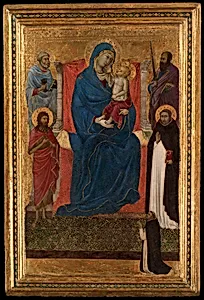
Virgin and Child Enthroned with Saints Peter, Paul, John the Baptist, and Dominic and a Dominican Supplicant
1325/35
Medium
Tempera on panel
Dimensions
37.2 × 23.2 cm (14 5/8 × 9 1/8 in.); Framed: 43.4 × 29.1 cm (17 1/8 × 11 7/16 in.)
Classification
tempera
Department
Painting and Sculpture of Europe
Museum
Art Institute of Chicago
Accession Number
25774
Rights
Public Domain
About this artwork
In 1260 Gerard de Frachet, an early chronicler of the Dominican order, noted that the friars had “in their cells . . . before their eyes images of Mary and her crucified son, so that while reading, praying, and sleeping they could look upon them and be looked upon by them, with eyes of compassion.” This image of the Virgin and Child with saints would have served such a purpose. A Dominican friar kneels before the enthroned Virgin, just below the figure of Saint Dominic, who intercedes on the fri...
Art Historical Context
Created around 1325–35 by the Sienese painter Ugolino di Nerio, this small tempera panel offers an intimate glimpse into early fourteenth-century Italian devotional art. Ugolino, a follower of Duccio, worked in the elegant Gothic style of Siena, where gold grounds and graceful figures helped worshippers feel closer to the divine. The compact size—roughly the dimensions of a large book—suggests it was made for private prayer rather than a grand church altar. The composition centers on the Virgin Mary enthroned with the Christ Child, surrounded by Saints Peter, Paul, John the Baptist, and Dominic. A kneeling Dominican friar at the lower right likely represents the original owner or donor, underscoring the panel’s personal significance. Tempera, made from powdered pigments mixed with egg yolk, allowed Ugolino to achieve the luminous colors and fine details that characterize Sienese painting of the period. Such works bridged the medieval and early Renaissance worlds, combining Byzantine formality with a growing interest in human emotion and natural space. Today in the Art Institute of Chicago, the painting continues to invite quiet reflection on faith, patronage, and the artistry of trecento Italy.