
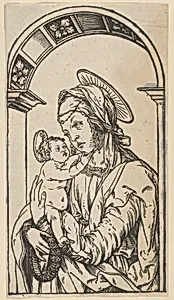
Virgin and Child Under an Arch
Medium
Woodcut; second state of two (Hollstein)
Dimensions
Sheet: 11 5/8 × 6 7/16 in. (29.5 × 16.4 cm)
Classification
Prints
Department
Drawings and Prints
Museum
Metropolitan Museum of Art, New York, NY
Credit
Rogers Fund, 1917
Accession Number
17.42.27
Rights
Public Domain
Tags
Art Historical Context
Hans Burgkmair's *Virgin and Child Under an* is a exquisite woodcut print from the early 16th century, capturing the tender devotion of the Madonna cradling the Christ Child beneath a graceful architectural frame. As a master of the German Renaissance, Burgkmair, based in Augsburg, was renowned for his innovative printmaking, blending intricate line work with a sense of depth and narrative warmth. This second state of two, as cataloged by Hollstein, reflects refinements in the printing process, likely enhancing clarity and contrast for broader distribution. Woodcuts like this one were revolutionary in their time, enabling affordable reproduction of sacred imagery for homes, churches, and pilgrims across Europe. The medium's bold, carved lines—cut into wooden blocks, inked, and pressed onto paper—allowed Burgkmair to evoke the soft curves of the Virgin's robes and the intimate gaze between mother and child, a ubiquitous motif in Northern Renaissance art symbolizing divine love and humanity. Measuring 11 5/8 × 6 7/16 inches, this intimate sheet now graces the Metropolitan Museum of Art's Drawings and Prints collection, acquired through the Rogers Fund in 1917. It invites visitors to appreciate how such prints bridged art and spirituality, making the holy accessible to all.
About the Artist
Hans Burgkmair · 1473–1531
Hans Burgkmair the Elder (1473–1531) was a German painter and printmaker who became one of the leading artists of the Renaissance in Augsburg. Born into a family of painters — his father, Thoman Burgkmair, was a respected artist — he likely received his initial training in his father's workshop. He may also have studied with Martin Schongauer in Colmar, and a probable visit to Italy around 1507 ex...