
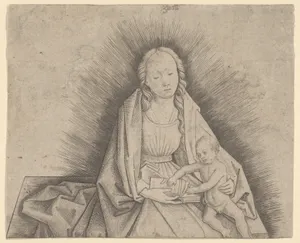
Virgin and Child (upper portion)
late 15th century
Medium
Engraving
Classification
Prints
Department
Drawings and Prints
Museum
Metropolitan Museum of Art, New York, NY
Credit
Gift of Felix M. Warburg and his family, 1941
Accession Number
41.1.174
Rights
Public Domain
Tags
Art Historical Context
This engraving of the Virgin and Child, created by the late fifteenth-century artist known as Master IAM of Zw, captures a tender moment between mother and infant in a composition that likely formed the upper section of a larger devotional print. Working in the Northern Netherlands, the artist employed the relatively new medium of engraving to render fine details with remarkable precision, from the delicate folds of drapery to the gentle expressions that convey both intimacy and reverence. Engraving allowed religious images like this Madonna and Child to circulate widely among the faithful during a period when printed works were transforming access to art. Unlike paintings made for churches or wealthy patrons, such prints reached a broader audience, serving as objects of private devotion and spiritual reflection. The Met’s impression, donated by the Warburg family in 1941, exemplifies how these works preserved intricate line work and symbolic depth across centuries. As a quintessential example of early Northern European printmaking, the piece highlights the era’s growing interest in naturalistic representation within a still deeply religious framework. Its classification among the museum’s prints underscores engraving’s lasting importance as both an artistic technique and a vehicle for cultural transmission.
About the Artist
Master IAM of Zwolle (Netherlandish) · 1465 –1495
Netherlandish, active ca. 1470–95