
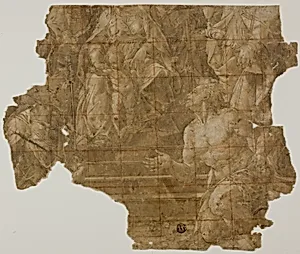
Virgin and Child with Saints (recto); Study of Arm (verso)
Medium
Pen and brown ink and brush and brown wash heightened with lead white (partially oxidixed) (recto), and black chalk (verso), on tan laid paper, squared in red chalk
Dimensions
25.2 × 29.2 cm (9 15/16 × 11 1/2 in.)
Classification
pen and ink drawings
Department
Prints and Drawings
Museum
Art Institute of Chicago
Accession Number
93622
Rights
Public Domain
Art Historical Context
This exquisite double-sided drawing by Bartolomeo Ramen the elder (known as Bagnacavallo dated around 1560–80, captures the Renaissance tradition of devotional art on its recto with a tender *Virgin and Child with Saints Rendered in pen and brown ink with brush and brown wash, with lead white (now partially oxidized for a subtle shimmer), the composition on tan laid paper exemplifies the meticulous preparatory sketches favored by Italian artists of the period. Squared in red chalk, it was likely a *modello*—a detailed study scaled up for a larger painting or fresco—highlighting the methodical transfer techniques of 16th-century workshops. On the verso, a black chalk study of an arm reveals Ramenghi's focus on anatomical precision, a hallmark of High Renaissance and early Mannerist draftsmen influenced by masters like Raphael, whom he emulated in Bologna. The modest dimensions (25.2 × 29.2 cm) belie its significance: such sheets were prized for training apprentices and refining compositions before committing to canvas or panel. Housed in the Art Institute of Chicago's Prints and Drawings Department, this work offers a window into the creative process of a Bolognese artist whose style bridged classicism and emerging Mannerism, blending piety with virtuoso technique for patrons seeking spiritual icons.