
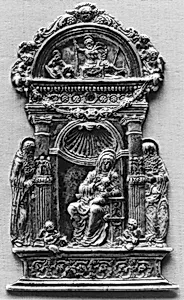
Virgin and Child Enthroned with Saints Anthony Abbot and Jerome
ca. 1490
Medium
Partially gilt silver
Dimensions
4 1/2 × 2 1/2 in. (11.4 × 6.4 cm)
Classification
Medals and Plaquettes
Culture
Italian, Verona
Department
European Sculpture and Decorative Arts
Museum
Metropolitan Museum of Art, New York, NY
Credit
Rogers Fund, 1913
Accession Number
13.121.2
Rights
Public Domain
Tags
Art Historical Context
In the late 15th century, Italian artist Galeazzo Mondella, known as Moderno, crafted this exquisite *Virgin and Child Enthroned with Saints Anthony Abbot and Jerome* around 1490 in Verona. Measuring just 4½ × 2½ inches, this partially gilt silver plaquette exemplifies the Renaissance fascination with small-scale sculpture. Plaquette—a flat relief plaque—served as a portable luxury item, cherished by collectors and devotees alike for its intricate detail and devotional power. The composition centers on the enthroned Madonna tenderly holding the Christ Child, flanked by Saints Anthony Abbot and Jerome, evoking a sacred hierarchy. Moderno's mastery shines in the fine chasing and gilding, which selectively highlights figures against a textured background, creating depth and luminosity on the precious metal. This technique not only enhanced realism but also symbolized divine radiance, aligning with Renaissance humanism's blend of piety and artistry. Housed in the Metropolitan Museum of Art's European Sculpture and Decorative Arts department, this Verona masterpiece reflects Italy's vibrant medal-making tradition, bridging jewelry craftsmanship and fine art. A testament to everyday spirituality, it invites us to ponder the intimate faith of Renaissance patrons.
About the Artist
Moderno (Galeazzo Mondella) · 1467–1528
Moderno, identified by scholars as the goldsmith and medallist Galeazzo Mondella (c. 1467–c. 1528), was among the most gifted Italian artists working in small-scale bronze and lead relief at the turn of the sixteenth century. The pseudonym Moderno, meaning simply "the modern one," signals both the esteem in which his contemporaries held his work and his own conscious alignment with the revival of ...