
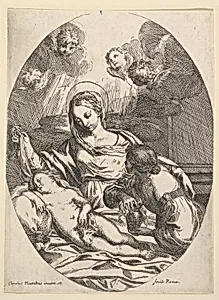
Virgin and Child with St. Mary Magdalen
17th century
Medium
Etching; second state of four (Bartsch)
Dimensions
sheet: 6 3/4 x 4 13/16 in. (17.2 x 12.2 cm)
Classification
Prints
Department
Drawings and Prints
Museum
Metropolitan Museum of Art, New York, NY
Credit
Harris Brisbane Dick Fund, 1926
Accession Number
26.70.3(65)
Rights
Public Domain
Tags
Art Historical Context
Carlo Maratti’s *Virgin and Child with St. Mary Magdalen* is a delicate seventeenth-century etching that captures the tender intimacy of a devotional scene. The Italian artist, a leading figure of the late Baroque period, specialized in graceful religious subjects that blended classical composure with emotional warmth. Here, the Madonna cradles the Christ Child while Mary Magdalene kneels in quiet reverence, accompanied by cherubic angels—an arrangement that reflects the era’s renewed emphasis on personal piety during the Counter-Reformation. Measuring just 6¾ by 4⅞ inches, this small print was designed for intimate contemplation rather than grand display. As the second state of four, it reveals Maratti’s careful revisions to the copper plate, demonstrating how etchers refined lines and tonal contrasts to achieve greater depth and luminosity. Such prints allowed Maratti’s elegant compositions, rooted in the traditions of Raphael and the Carracci family, to reach a wide audience beyond the walls of churches and palaces. Acquired by the Metropolitan Museum of Art through the Harris Brisbane Dick Fund in 1926, the work exemplifies the enduring appeal of Baroque devotional imagery. Its compact size and refined technique invite viewers to appreciate both the spiritual narrative and the subtle artistry of early modern printmaking.
About the Artist
Carlo Maratti · 1625–1713
Son of a Dalmatian father. Known as the last major Italian artist of the classical tradition, which had originated with Raphael. He created a grandiose and decorative style that was valued by his ecclesiastical patrons. Comment on works: History; Religious.