
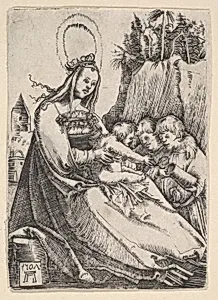
Virgin and Child with Two Boys
Medium
Engraving; first state of two
Dimensions
Sheet: 2 13/16 × 2 1/16 in. (7.1 × 5.2 cm)
Classification
Prints
Department
Drawings and Prints
Museum
Metropolitan Museum of Art, New York, NY
Credit
Gift of Felix M. Warburg, 1920
Accession Number
20.64.7
Rights
Public Domain
Tags
Art Historical Context
Albrecht Altdorfer, a pioneering artist of the Northern Renaissance and founder of the Danube School, created *Virgin and Child with Two Boys* in 1507. This intimate engraving depicts the Madonna tenderly holding the Christ Child, accompanied by two young boys—likely symbolizing devotion or future saints. Measuring just 2 13/16 × 2 1/16 inches, its diminutive scale was ideal for personal piety, allowing it to be carried in prayer books or worn as a talisman during the early 16th century. As a first-state impression of two, this rare print captures Altdorfer's masterful engraving technique before the plate wore down, preserving crisp lines and rich tonal depth. Working in Regensburg, Germany, he innovated with small-scale iron-plate engravings, blending meticulous detail with a sense of spiritual intimacy. Such Madonna and Child images were cultural staples, reflecting the era's fervent Marian devotion amid Reformation stirrings. Today, this gem resides in the Metropolitan Museum of Art's Drawings and Prints department, a gift of Felix M. Warburg in 1920. It exemplifies how prints democratized art, making sacred scenes accessible beyond grand altarpieces.
About the Artist
Albrecht Altdorfer · 1475–1538
Albrecht Altdorfer (c. 1480–1538) was a German painter, printmaker, and draftsman who stands as one of the founders of landscape painting as an independent genre. Born in Regensburg or nearby Altdorf, he learned art from his father Ulrich, a painter and miniaturist. Altdorfer spent most of his life in Regensburg, becoming a citizen in 1505 and later serving as the city's official architect and a m...