
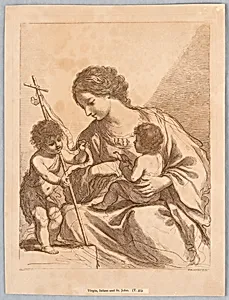
Virgin, Infant, and Saint John
Medium
Classification
Department
Smithsonian Collection
Museum
Smithsonian American Art Museum
Credit
Bequest of George Campbell Cooper
Accession Number
1896-3-264
Rights
Public Domain
About this artwork
Research in Progress
Art Historical Context
**Virgin, Infant, and Saint John** *Francesco Bartolozzi (Italian, active England, 1727–1815), ca. 1760–1770* *Print; Smithsonian American Art Museum, Bequest of Campbell Cooper* This tender print by Francesco Bartolozzi captures timeless religious motif: the Virgin Mary cradling the infant Christ, accompanied by the young Saint John the Baptist Created around 1760–1770, it reflects the enduring popularity of Madonna and Child imagery, rooted in Renaissance traditions but revived in the 18th century amid Europe's fascination with classical and devotional art. Bartolozzi, a Florentine engraver who moved to England in 1764, brought Italian finesse to British printmaking, producing works that bridged continental styles with local tastes. Renowned for pioneering stipple engraving—a technique using fine dots to build soft, painterly tones—Bartolozzi transformed prints from stark line work into luminous, tonal images rivaling paintings. This innovation made high-quality reproductions accessible, fueling the era's booming market for affordable art. Here, the dotted manner likely imbues the holy figures with gentle warmth and ethereal light, emphasizing maternal devotion and innocence. Housed in the Smithsonian American Art Museum's print collection, this piece (research ongoing) highlights Bartolozzi's influence on Anglo-Italian exchange. It invites visitors to ponder how such intimate scenes offered spiritual solace during the Enlightenment's rational shifts.