
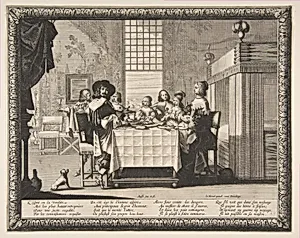
Virility
Medium
Etching
Dimensions
Sheet (trimmed): 10 1/16 × 12 11/16 in. (25.6 × 32.2 cm)
Classification
Prints
Department
Drawings and Prints
Museum
Metropolitan Museum of Art, New York, NY
Credit
Harris Brisbane Dick Fund, 1926
Accession Number
26.49.29
Rights
Public Domain
Tags
Art Historical Context
"Virility," an etching from 1636 by the French artists Abraham Bosse and Jean I Leblond, captures a lively domestic scene in a 17th-century dining room. Bosse, a pioneering etcher and member of the early Académie Royale de Pe et de Sculpture, collaborated with Leblond, a skilled engraver, to this intricate print measuring about 10 by 12 inches. Etching, their chosen medium, allowed for delicate lines and rich tonal effects by biting acid into a metal plate—a technique Bosse championed to reproduce detailed compositions affordably for a growing print market. The artwork depicts men, women, and girls gathered around a dining table, evoking the social rituals of French Baroque-era households. The provocative title "Virility" suggests themes of masculinity and vitality, perhaps playfully commenting on gender dynamics or courtship amid the meal. Bosse's prints often documented everyday life with remarkable realism, blending humor and observation to reflect the manners and fashions of Louis XIII's courtly world. Housed in the Metropolitan Museum of Art's Drawings and Prints department (Harris Brisbane Dick Fund, 1926), this piece exemplifies how prints democratized art, making sophisticated interiors accessible beyond elite patrons. Visitors will appreciate its window into 17th-century domesticity, where food, company, and subtle flirtations intertwined.
About the Artist
Abraham Bosse|Jean I Leblond · 1602–1676
Abraham Bosse (1604–1676) was a French printmaker and theorist whose approximately 1,600 etchings provide an unparalleled visual record of 17th-century French life. Born to Huguenot parents in Tours, he trained in Paris under Melchior Tavernier and became a devoted follower of Jacques Callot's technical innovations. Bosse's meticulous etchings depicted subjects ranging from daily life and fashion ...