
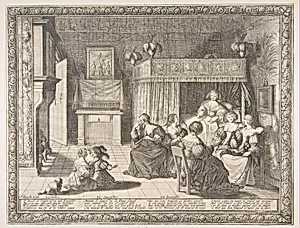
Visit to the New Mother
Medium
Etching with engraving; first state of two
Dimensions
Sheet (trimmed): 10 3/8 × 13 9/16 in. (26.4 × 34.5 cm)
Classification
Prints
Department
Drawings and Prints
Museum
Metropolitan Museum of Art, New York, NY
Credit
The Elisha Whittelsey Collection, The Elisha Whittelsey Fund, 1951
Accession Number
51.501.2235
Rights
Public Domain
Tags
Art Historical Context
"Visit to the New Mother," created in 1633 by Abraham Bosse in collaboration with publisher Melchior Tavernier, captures a tender domestic scene from 17th-century French life This etching with engraving portrays women and girls gathering around a new mother, reflecting the era’s social customs surrounding childbirth and female community. As a first state of two, the print preserves the artists’ original vision with crisp lines and delicate details. Bosse, a leading French printmaker of the Baroque period, specialized in genre scenes that documented everyday bourgeois existence with wit and precision. The medium of etching combined with engraving allowed him to render intricate textures—from clothing folds to interior furnishings—making these images widely accessible through reproduction. Housed in the Metropolitan Museum of Art’s Department of Drawings and Prints, the work offers modern viewers an intimate glimpse into historical rituals of care and celebration centered on women.
About the Artist
Abraham Bosse|Melchior Tavernier · 1602–1676
Abraham Bosse (1604–1676) was a French printmaker and theorist whose approximately 1,600 etchings provide an unparalleled visual record of 17th-century French life. Born to Huguenot parents in Tours, he trained in Paris under Melchior Tavernier and became a devoted follower of Jacques Callot's technical innovations. Bosse's meticulous etchings depicted subjects ranging from daily life and fashion ...