
Visiting a Temple
1797-1858
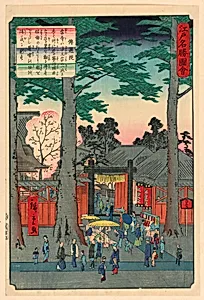
Medium
landscapes
Classification
landscapes
Department
Smithsonian Collection
Museum
Smithsonian American Art Museum
Credit
Gift of the Estate of Mrs. Robert H. Patterson
Accession Number
1941-31-321
Rights
Public Domain
About this artwork
Research in Progress
Art Historical Context
Ando Hiroshige (1797–1858), a master of Japanese ukiyo-e wood prints, captures the serene beauty of everyday life in *Visiting a Temple*. during Japan's Edo period (1603–1868), this landscape reflects the artist's fascination with travel, nature, and spiritual sites. Temples were central to Japanese culture, serving as places of pilgrimage, reflection, and seasonal festivals, and Hiroshige often depicted pilgrims journeying through picturesque countryside, blending human activity with atmospheric skies and winding paths. Hiroshige's style revolutionized landscape art in ukiyo-e, emphasizing subtle color gradients, bold compositions, and evocative weather effects achieved through precise woodblock printing techniques. His works, like those in famous series such as *The Fifty-Three Stations of the Tōkaidō*, influenced later artists worldwide, including European Impressionists. Though specific details of this print are under research, its classification as a landscape highlights Hiroshige's skill in evoking a sense of transience and harmony with nature. Now part of the Smithsonian American Art Museum's collection—gifted by the Estate of Mrs. Robert H. Patterson—this piece bridges Eastern artistry with American appreciation, inviting visitors to ponder Japan's rich visual tradition.