
Visiting Card Tray
c. 1941
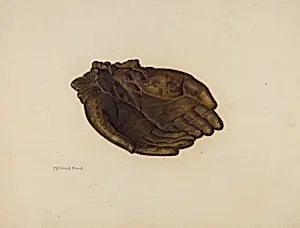
Medium
watercolor, pen and ink, and graphite on paperboard
Dimensions
overall: 29 x 36.5 cm (11 7/16 x 14 3/8 in.) Original IAD Object: 7 3/8" long; 5 1/2" wide; 1 3/4" high
Classification
Index of American Design
Department
CG-W
Museum
National Gallery of Art, Washington, D.C.
Credit
Index of American Design
Accession Number
1943.8.2072
Rights
Public Domain
Art Historical Context
Mildred Ford's *Visiting Card Tray*c. 1941) is a meticulous rendering of an elegant American decorative object, captured in watercolor, pen and ink, and graphite onboard. Measuring 29 x 36.5 cm overall, this artwork faithfully documents a small tray—originally 7 /8 inches long, 5 1/2 inches wide, and 1 3/4 inches high—designed to hold calling cards, a staple of 19th-century social etiquette. Ford's precise lines and subtle shading bring out the tray's intricate details, textures, and colors, transforming a functional household item into a celebrated artifact. Created as part of the Index of American Design, a Federal Art Project under the Works Progress Administration (WPA) during the Great Depression, this piece reflects a national effort to inventory and preserve everyday examples of American craftsmanship and folk art. Artists like Ford produced thousands of such illustrations between 1935 and 1942, ensuring that regional designs and historical objects were recorded for posterity amid economic hardship. Housed in the National Gallery of Art's collection (Department CG-W), it highlights the cultural role of decorative arts in American life. Ford's mixed-media technique—combining the fluidity of watercolor for depth, the sharpness of pen and ink for contours, and graphite for fine adjustments—exemplifies the Index's commitment to accuracy and artistry. Today, it invites us to appreciate the ingenuity of anonymous makers and the enduring charm of objects that once facilitated polite society.
About the Artist
Mildred Ford · 1895–1988
Mildred Ford (1895–1988) was an American artist whose career is indelibly linked to the Index of American Design, a monumental Works Progress Administration (WPA) project launched in the 1930s to document the nation's rich heritage of decorative arts and folk objects. Through her precise renderings, Ford helped preserve intricate details of everyday artifacts—from toleware utensils to Pennsylvania...