
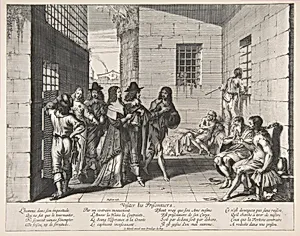
Visiting Prisoners
Medium
Etching; first state of two
Dimensions
Sheet (trimmed): 10 in. × 12 3/4 in. (25.4 × 32.4 cm)
Classification
Prints
Department
Drawings and Prints
Museum
Metropolitan Museum of Art, New York, NY
Credit
The Elisha Whittelsey Collection, The Elisha Whittelsey Fund, 1951
Accession Number
51.501.2263
Rights
Public Domain
Tags
Art Historical Context
"Visiting Prisoners," an etching from 1635 by French artists Abraham Bosse and Jean Leblond, captures poignant moment of human connection amid hardship. This first-state impression—before any later alterations—measures about 10 by 12¾ inches and belongs to the Metropolitan Museum of Art's Elisha Whittelsey Collection. B, a pioneering etcher renowned for his detailed depictions of 17th-century French society likely designed the composition, while Leblond have contributed to its production. The scene features men and women interacting with prisoners, evoking themes of charity and compassion in a grim institutional setting. Etching, Bosse's preferred medium, allowed for intricate lines and tonal effects that mimicked drawing, making prints like this accessible to a wider audience than paintings. As a key figure in the French print world, Bosse advanced the technique during the reign of Louis XIII, blending realism with social observation in the style of contemporaries like Jacques Callot. This work reflects the era's prison conditions, where visitors—often family or almsgivers—provided vital relief in overcrowded, debtor-filled jails. A rare survivor in its pristine first state, "Visiting Prisoners" offers insight into Baroque-era urban life and the era's moral imperatives. Its presence in the Met's Prints department underscores the enduring value of such documentary etchings as windows into history.
About the Artist
Abraham Bosse|Jean I Leblond · 1602–1676
Abraham Bosse (1604–1676) was a French printmaker and theorist whose approximately 1,600 etchings provide an unparalleled visual record of 17th-century French life. Born to Huguenot parents in Tours, he trained in Paris under Melchior Tavernier and became a devoted follower of Jacques Callot's technical innovations. Bosse's meticulous etchings depicted subjects ranging from daily life and fashion ...