
Visjnoe
1200
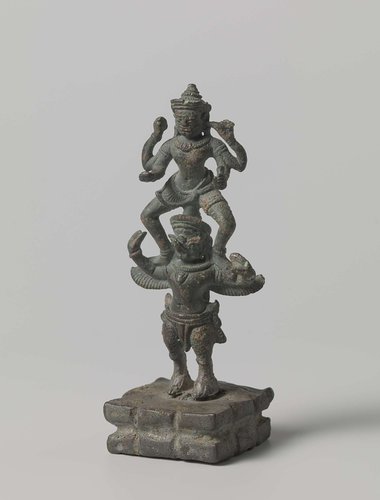
Medium
bronze (metal)
Dimensions
12; 4; 8
Rights
Public Domain
About this artwork
On loan from the Royal Asian Art Society in The Netherlands (C.S. Lechner bequest, 1967)
Art Historical Context
**Visjnoe** *Anonymous, c. 1200, bronze, h 12 × w 8 × d 4 cm* On loan from the Royal Asian Society in The Netherlands (C.S.chner bequest, 7) Nestled in the rich tradition of medieval Asian artistry, this compact bronze sculpture titled *Visjnoe*—likely a Dutch transliteration evoking the revered Hindu deity Vishnu—dates to around 1200 CE. Crafted by an anonymous artist, its modest dimensions (just 12 cm tall) suggest it was designed for intimate devotion, perhaps as a portable shrine object carried by pilgrims or placed in a household altar. Bronze, a durable and prestigious medium in Asian cultures, allowed for intricate detailing through the lost-wax casting technique, where molten metal fills a wax mold, capturing fine textures and forms with remarkable precision. This artifact highlights the cultural flourishing of Hindu-Buddhist iconography in Southeast Asia during the 13th century, a period when such small-scale bronzes bridged temple grandeur with personal piety. Its survival speaks to the enduring legacy of skilled metallurgists who alloyed copper and tin for a warm, golden patina that deepens with age. On loan from the Royal Asian Art Society's 1967 bequest, *Visjnoe* invites us to ponder the anonymous hands that shaped divinity, connecting us to spiritual lives from eight centuries past. (198 words)
About the Artist
anonymous
In the vast tapestry of art history, "Anonymous" stands not as a singular individual but as a collective designation for countless unidentified creators whose works have endured across millennia. These artists, spanning prehistoric cave painters to medieval illuminators and folk craftsmen, produced the foundational layers of human visual culture. Prior to the Renaissance, when individual fame emer...