
Visored Bascinet
1390/1400
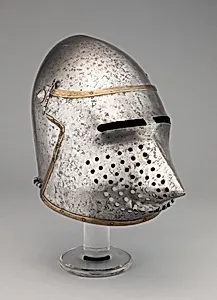
Medium
Steel and brass
Dimensions
H.: 24.1 cm (9 1/2 in.)
Classification
suit-helmet
Department
Applied Arts of Europe
Museum
Art Institute of Chicago
Accession Number
112065
Rights
Public Domain
About this artwork
The quintessential knightly helmet of the late 14th century, the bascinet was used throughout Europe. Its pronounced conical skull and pointed visor were designed to deflect blows side to side and were described in its own time in Germany as a Hundsgugel, or hound’s hood. The pierced steel pins around the base of the skull were used to attach a mail hood, called an aventail, that protected the shoulders. Complete surviving examples are rare. This helmet is made of two separate period parts, sku...
Art Historical Context
Step into the armored world of late medieval Europe with the *Visored Bascinet a striking helmet from around 1390–1400, now housed in the Art Institute Chicago's Department of Applied Arts of Europe This steel and brass helmet, standing just 24.1 cm tall, exemplifies the pinnacle of 14th-century armor craftsmanship. Classified as a suit-helmet, it was designed to integrate seamlessly with a full suit of plate armor, offering knights vital head protection during the turbulent era of the Hundred Years' War and feudal conflicts. The bascinet's signature visor—a pivoting face guard—marked a revolutionary advancement in helmet design, balancing fierce defense with improved visibility and breathability for the wearer. Forged from durable steel and accented with brass for rivets and reinforcements, it reflects the era's masterful metalworking techniques, likely involving hammering, shaping, and polishing by skilled armorer-smiths whose identities remain unknown. These helmets were not mere tools of war but symbols of chivalric status, worn by nobility in tournaments and battles across Italy, Germany, and beyond. Today, this artifact invites us to ponder the human ingenuity behind medieval warfare, blending functionality with subtle artistry in the Applied Arts tradition. A testament to survival and splendor, it reminds visitors of a time when steel shaped history.
About the Artist
Unknown
The artist designated as "Unknown" in our virtual museum's collection exemplifies a poignant chapter in art history: creators whose identities have faded into obscurity despite the enduring power of their work. With only one known artwork attributed to them in our holdings, this figure represents countless anonymous hands that shaped visual culture across centuries. Museums worldwide, including th...