
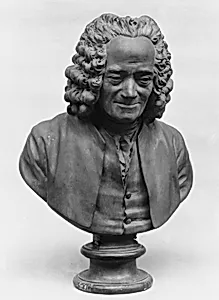
Voltaire (Marie François Arouet, 1694–1778)
late 18th century, after model of 1778
Medium
Painted plaster; painted and gilded wood
Dimensions
Height (bust only): 26 1/2 in. (67.3 cm)
Classification
Sculpture
Culture
French
Department
European Sculpture and Decorative Arts
Museum
Metropolitan Museum of Art, New York, NY
Credit
Gift of J. Pierpont Morgan, 1908
Accession Number
08.89.1a, b
Rights
Public Domain
Tags
Art Historical Context
This striking bust captures the likeness of Voltaire, the renowned French Enlightenment writer and philosopher born Marie François Arouet (1694–1778). Created by Jean-Antoine Houdon, one of the leading sculptors of his era, the work dates to the late eighteenth century and follows a model Houdon produced in 1778, the year of Voltaire’s death. As a French neoclassical artist celebrated for his lifelike portraits of intellectual figures, Houdon brought both precision and vitality to representations of the era’s leading minds. The sculpture’s medium—painted plaster mounted on painted and gilded wood—highlights Houdon’s practical approach to portraiture. Plaster allowed for multiple casts after the original clay or marble versions, making important likenesses widely available to admirers and collectors. The modest scale (just over two feet high) and careful polychromy give the bust an intimate, almost lifelike presence, inviting viewers to engage directly with Voltaire’s sharp, expressive features. Housed today in the Metropolitan Museum of Art’s Department of European Sculpture and Decorative Arts, this piece entered the collection as a 1908 gift from financier J. Pierpont Morgan. It stands as a testament to the enduring cultural reverence for Voltaire’s ideas and to Houdon’s skill in preserving the personalities of the Enlightenment for future generations.