
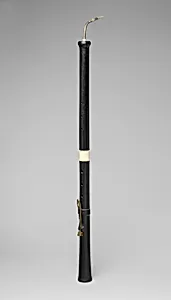
Vox Humana in F
ca. 1800–1825
Medium
Wood, brass, ivory
Dimensions
Length (w/o crook) 730 mm, Diameter of bell 45 mm, Upper section 348 mm, Lower section 415 mm.
Classification
Aerophone-Reed Vibrated-double reed
Culture
British
Department
Musical Instruments
Museum
Metropolitan Museum of Art, New York, NY
Credit
The Crosby Brown Collection of Musical Instruments, 1889
Accession Number
89.4.1135
Rights
Public Domain
Art Historical Context
Step into the enchanting world of 19th-century British music with the *Vox Humana in F crafted around 1800–1825 by William Maurice Cahusac a skilled member of a renowned London family of instrument makers. This double-reed aerophone, tuned to F, measures about 730 mm in length (without its crook), with a slender bell diameter of 45 mm.ed from rich woods for the body, gleaming brass for keys and fittings, and smooth ivory accents, it exemplifies the exquisite craftsmanship of the Georgian era, where materials were chosen not just for durability but for their acoustic resonance and visual elegance. Named "Vox Humana"—"human voice" in Latin—this instrument was celebrated for its haunting, vocal-like timbre, bridging the gap between orchestral woodwinds like the oboe and more intimate chamber music. Double-reed designs, vibrating two closely set reeds against each other, produced a piercing yet expressive tone ideal for military bands, theaters, and early Romantic ensembles. Its segmented construction—348 mm upper and 415 mm lower sections—allowed for precise tuning and portability. Generously donated as part of The Crosby Brown Collection in 1889, this piece at The Metropolitan Museum of Art highlights Britain's golden age of instrument-making innovation. Visitors, imagine its reedy song echoing through candlelit halls— a testament to how music captured the human spirit in an age of industrial change.