
Vrouwenhoofd
1738 - 1779
Medium
paper
Dimensions
400; 270
Rights
Public Domain
About this artwork
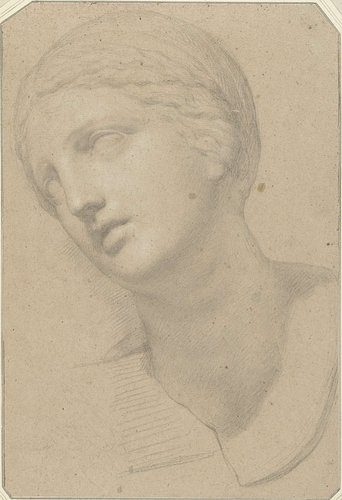
Vrouwenhoofd, naar antiek voorbeeld, in pleister.
Art Historical Context
Anton Raphael Mengs’s *Vrouwenhoofd* (Woman’s Head) is a sensitive study on paper that captures the serene profile of a female figure modeled after an antique plaster cast. Created sometime during the artist’s career (1738–1779), the drawing measures 400 × 270 mm and reflects Mengs’s lifelong practice of drawing directly from classical sculpture. By working from a plaster cast rather than a living sitter, Mengs distilled the idealized proportions and calm expression prized in ancient art. Mengs, a leading voice of early Neoclassicism, believed that careful study of Greco-Roman antiquities could restore nobility and clarity to modern painting. Drawings such as this one served both as training exercises and as visual notes he could consult when composing larger history paintings. The choice of paper allowed for quick, precise line work and subtle tonal modeling, techniques that helped him internalize the harmonious contours of classical heads. Today the sheet offers visitors a glimpse into an eighteenth-century artist’s dialogue with the ancient past. It reminds us how Neoclassical creators bridged centuries by copying, analyzing, and ultimately reinterpreting the timeless beauty of antique forms.
About the Artist
Anton Raphael Mengs · 1728–1779
Comment on works: Portraits; Religious