
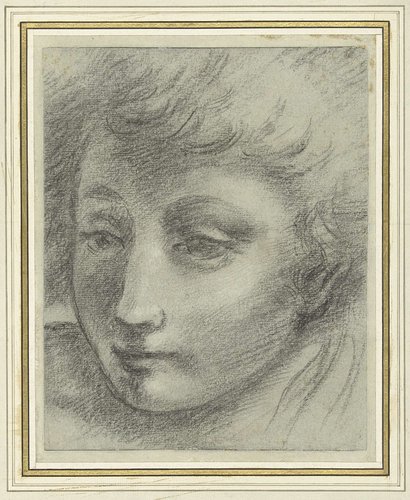
Hoofd van jongen
1540 - 1612
Medium
paper
Dimensions
205; 255
Rights
Public Domain
About this artwork
hoogte 255 mm x breedte 205 mm
Art Historical Context
Federico Barocci (c. 1526–1612), a master of the late Renaissance transitioning into the early Baroque, created *Hoofd van jongen* ("Head of a Boy a delicate drawing on paper measuring 255 mm high by 205 mm wide. This intimate study exemplifies Barocci's renowned skill in capturing human expression with soft, naturalistic modeling. Working primarily in Urbino, Italy, he produced numerous preparatory sketches like this one, often using chalk or ink to explore light, shadow, and emotion before committing to larger oil paintings. Barocci's drawings were pivotal in his process, blending Mannerist elegance with emerging Caravaggesque realism. His heads, such as this youthful boy's, reveal a tender sensitivity to anatomy and psychology, influenced by his study of Correggio and Raphael. Though small in scale, the work's fine lines and subtle tonal gradations highlight paper's versatility as a medium for Renaissance artists, allowing for quick yet profound explorations. This piece invites visitors to appreciate Barocci's innovative technique, bridging the idealized forms of the High Renaissance with the emotional depth of the Baroque. A gem for drawing enthusiasts, it underscores how such studies fueled some of the era's most evocative religious and portrait works.
About the Artist
Federico Barocci · 1535–1612
Federico Barocci (c. 1535–1612) was an Italian painter from Urbino whose luminous, emotionally tender religious paintings made him one of the most original and influential artists of the late sixteenth century, bridging Mannerism and the early Baroque. Born in Urbino, the city of Raphael, he studied under Battista Franco and traveled to Rome, where he absorbed the lessons of Raphael, Correggio, an...